

How Much Will It Cost To Install A Ceiling Fan
In this guide
Ceiling Fan Computer
Indoor vs Outdoor Ceiling Fan Cost
Ceiling Fan Prices by Size
Ceiling Fan Costs by Type
Ceiling Fan Blade Toll past Material
Ceiling Fan Prices by Number of Blades
Outdoor Ceiling Fan Cost by Rating
Ceiling Fan Cost With Downrod
Average Price of a Ceiling Fan by Style
Boilerplate Cost of a Ceiling Fan by Brand
Labor Price to Install a Ceiling Fan
Ceiling Fan Replacement Price
Cost to Run a Ceiling Fan
Smart Ceiling Fan Price
Energy Star Ceiling Fan
Maintenance
Ceiling Fan vs Wall Fan Cost
Ceiling Fans vs Air Conditioner Cost
Enhancement and Comeback Costs
Additional Considerations
FAQs
Ceiling Fan Calculator
Ceiling Fan Reckoner
Costs to install a ceiling fan vary greatly past region. Let'due south calculate the cost for your nada lawmaking.
Want to receive more than accurate estimates for your project?

Encounter Ceiling Fan Computer Breakdown
Toll
Textile

42" four-blade fan, white finish
$148
Labor
Installing and connecting a 42" four-blade fan
$104
Material
48" five-blade rattan fan
$294
Labor
Installing and connecting a 48" five-blade fan
$104
Materials
56" five-blade leaf-design premium fan
$457
four light bulbs, ball pull chain, brass trim, and vaulted ceiling mountain
$97
Labor
Installing and connecting a 56" 5-blade fan
$104
Installing 4 lite bulbs, ball pull chain, brass trim, and vaulted ceiling mount
$45
Total
$252
$398
$703
Indoor vs Outdoor Ceiling Fan Cost
When deciding between a ceiling fan for an outdoor space versus an indoor space, it is important to check the specific fan for its wet tolerance. Indoor fans that are rated for dry-just spaces cannot be used exterior. However, an outdoor unit can be used inside considering exposure to moisture volition not impact the fan. Indoor ceiling fans starting time as depression equally $200 and may go up to over $800. Your outdoor unit price starts closer to $300 and goes to over $900.
The principal difference betwixt indoor and outdoor fans is their construction materials. To withstand the moisture of an outdoor environment, a manufacturer coats an outdoor fan's blades with plastic or constructs the blades entirely of plastic or stainless steel. Outdoor fans likewise tend to have more robust motors and components capable of withstanding humidity and inclement conditions.


| Type | Average Cost (Materials Just) |
|---|---|
| Indoor | $200 - $800 |
| Outdoor | $300 - $900 |
Ceiling Fan Prices past Size
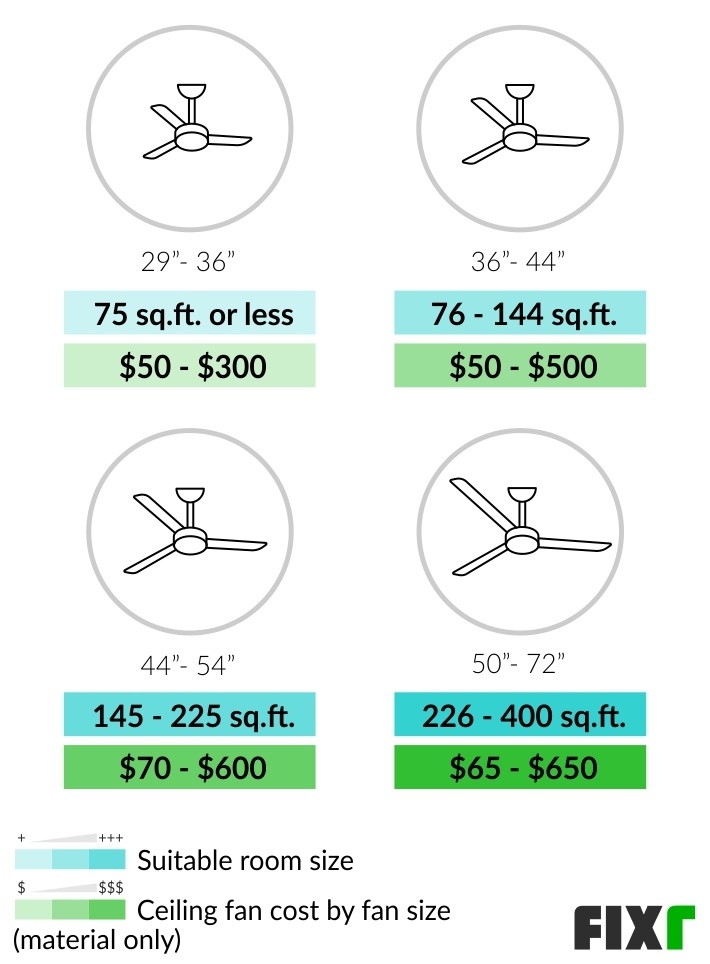
The easiest manner to figure out what size fan you demand is to mensurate the room where you desire to hang it and purchase accordingly. The size of a ceiling fan is based on the measurement of its blade span: the diameter range of the blades while they rotate. This can be measured in 2 ways, depending on whether the fan has an odd or even number of blades. With an fifty-fifty number of blades, you may measure the diameter easily from the tip of one bract to the tip of the blade that is direct opposite. For an odd-bladed fan, measure from the center of the fan to the end of one of the blades and multiply that result by two for your total fan diameter.

| Fan Size | Suitable Room Size | Boilerplate Cost (Materials Only) |
|---|---|---|
| 29" - 36" | 75 sq.ft. or less | $50 - $300 |
| 36" - 44" | 76 sq.ft. - 144 sq.ft. | $50 - $500 |
| 44" - 54" | 145 sq.ft. - 225 sq.ft. | $70 - $600 |
| 50" - 72" | 226 sq.ft. - 400 sq.ft. | $65 - $650 |
Ceiling Fan Costs by Blazon
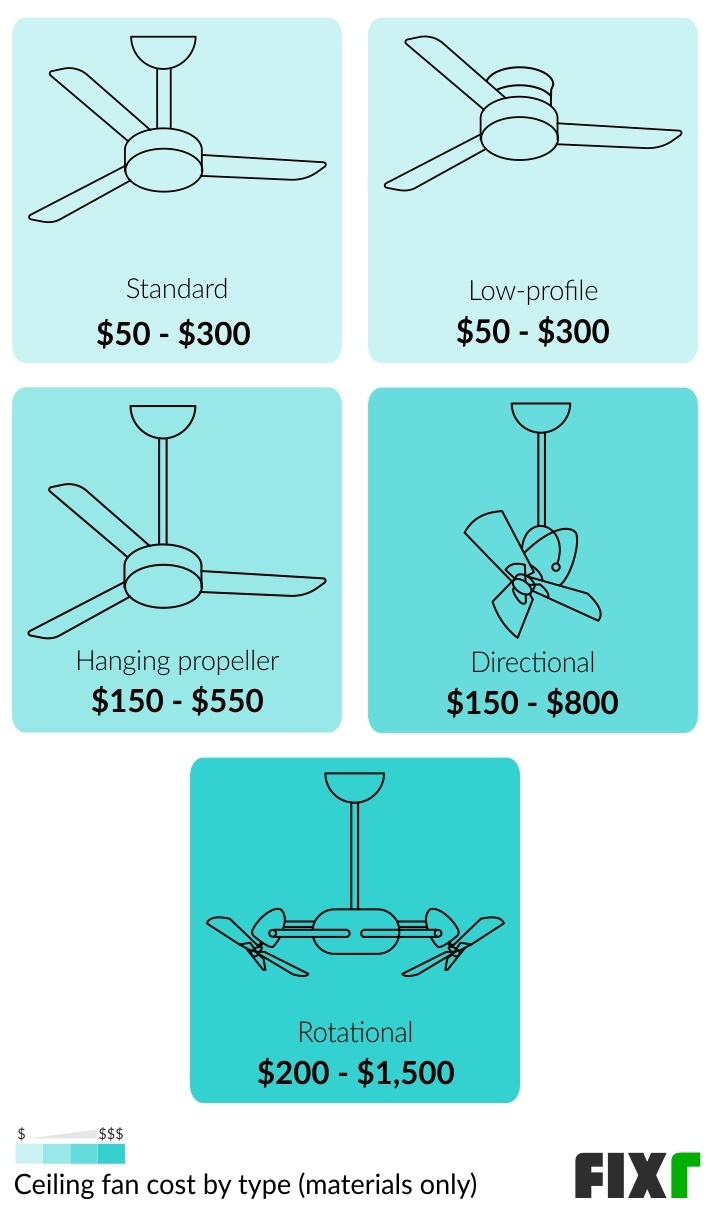
Ceiling fan manufacturers offer incredible variety with their design choices, but the visual appeal is non the simply design factor impacting price. Some design features that touch the toll of a ceiling fan include whether you tin can conform the direction of the unit, whether your contractor tin can mountain the unit on a wall, and whether the fan has a computer to connect it to a smart home arrangement.

| Type | Average Cost (Materials But) |
|---|---|
| Standard | $50 - $300 |
| Depression-Profile | $fifty - $300 |
| Hanging Propeller | $150 - $550 |
| Directional | $150 - $800 |
| Rotational | $200 - $one,500 |
Price of a Standard Ceiling Fan
A standard ceiling fan costs from $50 to $300. This is the type of fan unremarkably found in most homes. They point straight downward and have blades that rotate parallel to the ceiling. Nigh take five blades and a built-in calorie-free fixture. Upgrades and features you might see with standard units include pull chains, remote controls, and wall controls. Manufacturers offer fans in virtually every cease, including standard black or white and natural wood finishes.
Low-Profile
Depression-contour units cost approximately $50 to $300. Besides known as "flush mountain" or "hugger" fans, depression-contour fans are designed to keep the blades close to the ceiling. This makes them suitable for ceilings 8' or lower. Low-contour ceiling fans are too an excellent choice for small-scale rooms, even if the ceilings are tall because they movement air very efficiently in a pocket-sized space.
Hanging Propeller
A hanging propeller unit of measurement costs betwixt $150 and $550. This fan type has its propeller and blades hanging downwards from a "downrod," a pole that extends downward from the fan's base. Because they hang lower than other fans, they are all-time for ceilings 9' or higher. Hanging propeller fans are very effective in helping to estrus or cool your home each season when you reverse the management the blades spin.
Directional
A directional model costs betwixt $150 and $800. Directional fans can be adjusted to point in whichever management you prefer at that place to exist targeted airflow. Their construction is similar to a standing fan, albeit mounted upside-down (with a downrod). It is important to correctly measure out the directional unit you want to install to ensure it functions properly without hitting anything.
Rotational Ceiling Fan
Rotational ceiling fans cost from $200 to $1,500. Rotational or "dual-motor" fans are typically directional fans with dual heads, which rotate on an axis (a downrod). Dual motor units are a popular choice when looking for a modern aesthetic for your living infinite. Dual-motor fans also motion more air than single-motor fans, making them a great selection for big rooms. They besides simply need a single electric box despite having two motors.
Ceiling Fan Blade Toll by Fabric
Your selection of blade cloth raises or lowers the total toll of your fan. Different materials act differently when moving air, so yous may detect information technology helpful to consider the pros and cons of each.
Metal blade fans motility air more efficiently than wood blade fans, but metal fans are a little louder. Your conclusion might come up downwardly to noise versus efficiency. If it is a toss-upwards for you between aluminum blades or steel blades, the choice might depend on where yous desire to put the fan. Stainless steel blades are an splendid design pick for mod homes, but they are also best for damp environments where rust could become a problem. Nonetheless, aluminum blades offering some of the quietest and most efficient operation.
Plastic too has some benefits that might encourage you to consider plastic options for your ceiling fan installation. Not only are they cheaper, only they even last longer. Less weight on the fan blades means less wear on the fan motor and a longer life bridge. Some other option is a fan made of actual palm leaves. These fans are lightweight similar plastic fans, but they are more than sustainable than plastic fans.
If you lot are not a fan of stainless steel or plastic and want something different, yous might choose Medium Density Fiberboard (MDF), a combination of recycled wood particles and resin. It withstands incredible temperature variations, which can warp traditional wood, and is too long-lasting because of its composite construction.


| Fabric | Average Cost (Materials Only) |
|---|---|
| MDF | $45 - $450 |
| Plastic | $fifty - $200 |
| Aluminum | $lx - $400 |
| Steel | $seventy - $1,500 |
| Palm Leaves | $100 - $450 |
| Wood | $100 - $one,400 |
Ceiling Fan Prices past Number of Blades
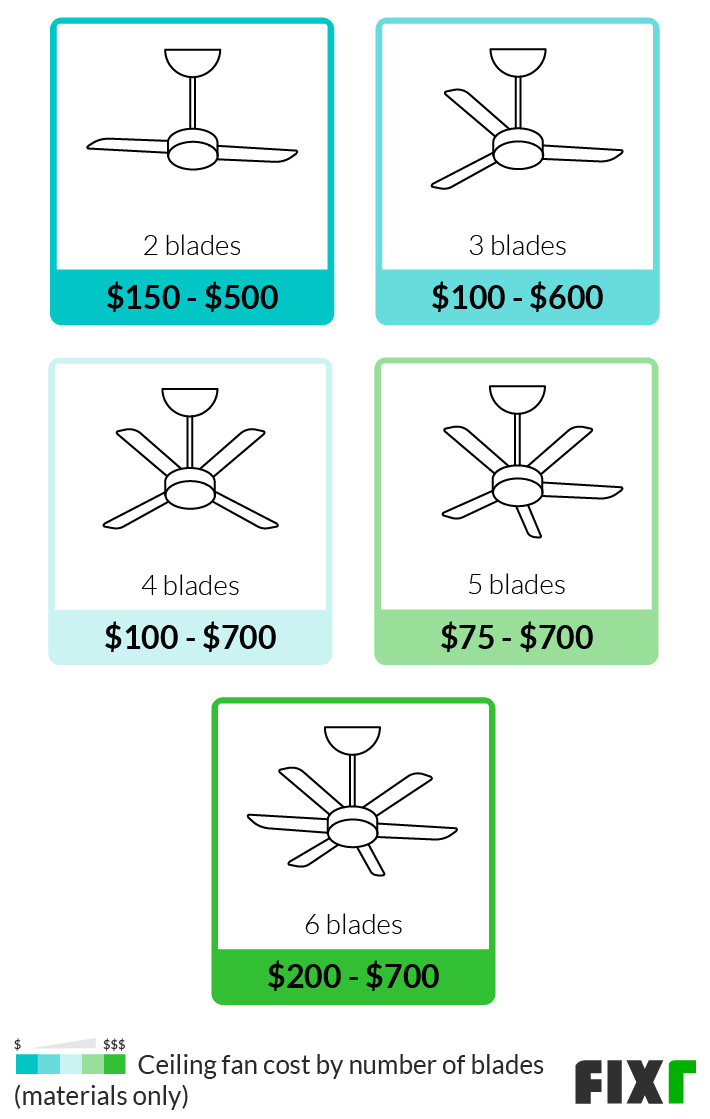
Fans are commonly manufactured with two to six blades. Your option often comes down to aesthetics. A fan with ii blades offers an incredibly modern look, while a five-bract fan fits nicely in a traditional interior. The well-nigh affordable fans tend to have five blades and are available in many appealing styles, while two-bract fans often sell as a premium designer option. If y'all accept a small room, you might choose a fan with fewer blades to create a less cluttered look. On the other paw, ii- and iii-blade fans are usually louder than five-blade fans, so you might cull a fan with five blades if you adopt less noise from your fan. Aesthetics impact fan selection, but functionality also counts.

| Number of Blades | Average Cost (Materials Only) |
|---|---|
| 2 Blades | $150 - $500 |
| 3 Blades | $100 - $600 |
| 4 Blades | $100 - $700 |
| 5 Blades | $75 - $700 |
| 6 Blades | $200 - $700 |
Outdoor Ceiling Fan Cost by Rating
If y'all are because installing a fan in an outdoor area, yous cannot go with a normal indoor fan. Their motors and structural materials are not made to withstand outdoor elements. This is why you need to pick a model specifically designed for outdoor installation. You lot'll find nearly types of fans bachelor in dry, damp, and wet ratings. Their prices differ based on the rating. In that location are three types of ceiling fans, categorized by the UL's Damp-moisture rating.


| Type | Average Cost (Materials But) |
|---|---|
| Dry out-Rated | $100 - $1,000 |
| Damp-Rated | $125 - $ane,100 |
| Moisture-Rated | $150 - $1,200 |
Dry-Rated
Dry-rated ceiling fans cost $100 to $1,100. Dry-rated ceiling fans are designed for indoor areas that are not exposed to moisture. This includes most rooms of the home, including bedrooms, dining rooms, workshops, finished basements, and foyers. A dry out-rated unit can be used in a kitchen with proper ventilation.
Damp-Rated
Clammy-rated fans range from $125 to $ane,100. They are resistant to high humidity and condensation, simply you lot cannot become them completely moisture. They are an excellent pick for an enclosed expanse like a patio or garage where you exercise not take complete command of the climate. They also work well in naturally damp rooms like bathrooms and laundry rooms. Damp-rated units are convenient because they are usable both indoors and outdoors.
Wet-Rated
Moisture-rated ceiling fans range from $150 to $1,200 and are resistant to rain, snowfall, and wind. They are a terrific choice for outdoor areas where h2o and moisture could accomplish the unit or its motor. You lot can take a hose to a wet-rated unit to clean it since the wiring is waterproof and the blades are resistant to warping from coming into contact with water. You lot might install a wet-rated unit in a gazebo where inclement weather could accomplish the fan.
Ceiling Fan Cost With Downrod
A downrod is a pipe or an extension that connects a fan motor housing to the hardware at the ceiling. If your ceiling is high plenty (at least 8 feet just even higher is meliorate), installing a unit of measurement with a downrod provides increased air circulation and greater stability for the fan. Some fans ship with downrods included, but they are usually only a few inches long. Yous can cull a longer downrod based on the height of your ceiling. Costs vary from but $v for a bones 6-inch downrod to $110 for a 72-inch downrod. See the tabular array below to acquire what fan downrod lengths are suggested for specific ceiling heights. Keep in heed that these costs are solely for purchasing a downrod and may increase the overall cost.


| Ceiling Height | Downrod Length in Inches | Average Cost (Materials Merely) |
|---|---|---|
| ix Feet | 6 | $3 - $20 |
| 10 Anxiety | 12 | $6 - $85 |
| 12 Feet | 24 | $xi - $75 |
| 14 Anxiety | 36 | $10 - $75 |
| 16 Feet | 48 | $25 - $100 |
| eighteen Feet | 60 | $30 - $100 |
| xx Feet | 72 | $35 - $110 |
Average Cost of a Ceiling Fan by Way
The style of the fan is 1 of the leading factors that people consider. The creativity in design is endless. 1 of the most pop types selling today is the modernistic mode, which often features metal construction or a metallic blanket. Related is the industrial style, which may take things a footstep further into the minimalistic realm and is a popular option. Nevertheless, if yous are non a fan of these styles, search for fans under the traditional or contemporary style.
If your house is a trivial older or has some old-fashioned character, yous take some excellent options with rustic or farmhouse fans. These options are non just for legitimate farms; however, they are a beautiful choice when you have a home with a farm kitchen and reclaimed forest decor. Y'all may also opt for a specialty fan similar a Mission-style fan, which is a wonderful add-on to whatsoever home with exposed wood beams and congenital-in bookshelves.
If you lot have an island theme in your home or on a dorsum deck, you might choose a specialty fan like the tropical fan. These delicately ornate fans unremarkably characteristic blades that look like palm fronds. Some tropical fans actually feature real palm leaves. If you like new trends, you might retrieve about a "fandelier," which looks similar a chandelier but operates similar a normal fan. They are generally priced from $230 to $2,000.
Each of these styles is bachelor in a readymade format from major retailers and through your contractor or installer. You can also seek designer options that get-go effectually $1,500 for an industrial model up to $15,000 for a "fandelier" or a modern unit. Designer fans may come up from a respected pattern studio, or they may be custom-made to your specifications.


| Manner | Boilerplate Price (Materials But) |
|---|---|
| Modern | $40 - $2,000 |
| Industrial | $l - $500 |
| Traditional | $50 - 900 |
| Rustic | $50 - $one,200 |
| Farmhouse | $l - $i,200 |
| Contemporary | $fifty - $1,250 |
| Mission Way | $100 - $700 |
| Victorian | $100 - $2,200 |
| Windmill | $100 - $1,500 |
| Tropical | $150 - $1,850 |
| Lantern | $150 - $3,000 |
| Fandelier | $230 - $2,000 |
Boilerplate Cost of a Ceiling Fan by Brand
Well-known ceiling fan companies include Emerson, Westinghouse, and Hunter. These and other manufacturers pattern fans at virtually every toll point even though some companies are considered high-end, and others offer more standard machines. For instance, Hunter manufactures many beautiful fans, but their subsidiary, Casablanca, is more high-end. However, price is not the only factor when information technology comes to quality. You may observe it helpful to read online reviews about different fans to get a sense of a company's reputation and the quality of their products, whether they are affordable or expensive.


| Make | Boilerplate Cost (Materials Only) |
|---|---|
| Westinghouse | $55 - $1,700 |
| Hunter | $90 - $1,200 |
| Kichler | $100 - $1,000 |
| Monte Carlo | $170 - $i,000 |
| Minka-Aire | $200 - $1,100 |
| Casablanca | $400 - $700 |
Labor Price to Install a Ceiling Fan
Several variables impact the cost of installing a ceiling fan. The price of a ceiling fan unit ranges from equally low every bit $40 to as much as $3,000, depending on the design, quality, and additional features. Labor for an electrician to install the unit typically costs an additional $60 to $320, depending on the complexity of the installation.
Indoor installations usually cost between $60 and $250. Outdoor installations toll betwixt $150 and $320. Outdoor installation comes in at the college end of the calibration because of the need for added materials like electrical conduits to business firm the wires and weatherproof fittings, which take additional time to install. If you opt for a handyman instead of an electrician, they usually accuse $60 to $90 per hour to install your ceiling fan.
Some installations can get complicated and may require cutting into the walls to run wires, pushing the installation toll to the top of the range. Other install jobs might accept just a half-hour and crave cypher more than removing an old fan and installing the new unit.
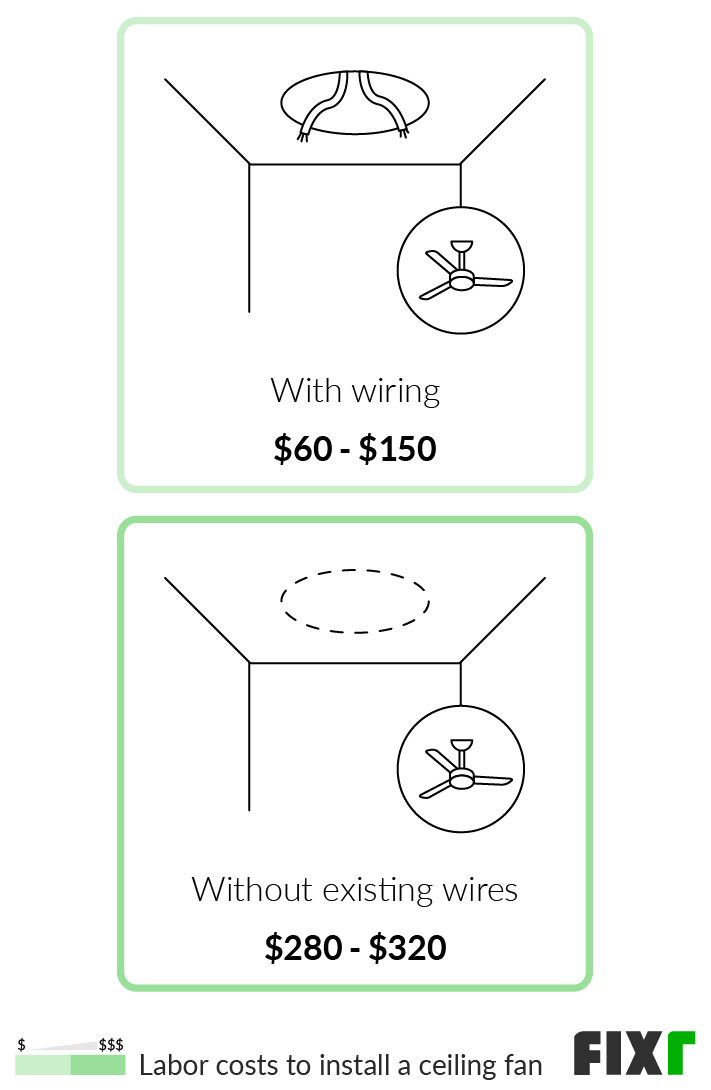
| Labor Type | Labor Costs |
|---|---|
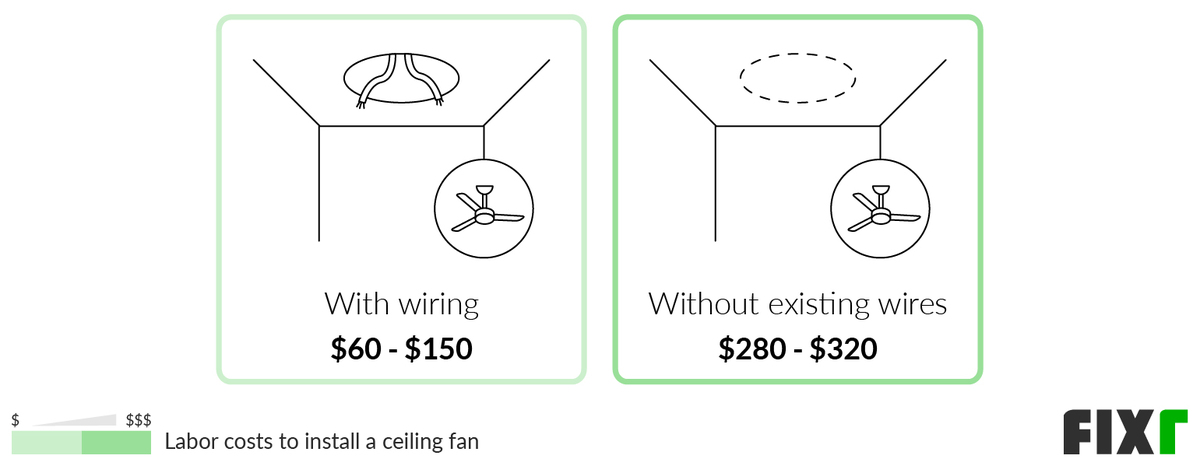
| With Wiring | $lx - $150 |
| Without Existing Wires | $280 - $320 |
Cost to Install Ceiling Fan With Wiring
If your abode already has a fan and yous have hired a handyman or electrician to install a new unit, you are in luck. These replacement installations oftentimes keep quickly because your professional person uses the existing wiring to claw upwardly your new fan. Your cost for labor should range from $lx to $150 since the work should take less than an hour to complete.
With a shine and easy installation, you can expect your total installation costs to sit down at the lower end of the $350 to $650 national average; however, your costs may increase with an expensive unit. You lot tin often go a soft quote over the phone for installation work when the project is a simple replacement with existing wiring.
Cost to Install Ceiling Fan Without Existing Wires
When you want to install a fan where no wiring currently exists, the complication, cost, and timeline of the project increment. At a minimum, your electrician needs to install a fan-rated electric box, wiring, and a switch. The labor costs $280 to $320 because of the additional time required. Total installation costs will likely striking the college end of the $350 to $650 average installation toll because of the additional materials needed.
A few questions you need to answer before your handyman or electrician begins piece of work include the location where you want the new wall switch and the placement of the new unit. You lot need to figure out the direction of the joists that run across the ceiling and how they run in relation to the new unit and its wall switch. Your professional installer needs to connect the power switch to an existing line in the wall to power your fan. They can ability the unit of measurement directly from a line in the ceiling if y'all cull to use a remote with your fan. Final considerations include figuring out the composition of the walls (drywall or plaster) and whether any patching might be necessary later on the installation.
Ceiling Fan Replacement Cost
When replacing an existing ceiling fan with another unit, in that location is frequently no need to update the wiring. Replacing an old ceiling fan with a new unit that does not require any additional wires is very straightforward and may only have a handyman an hour to assemble the new fan and install information technology at a rate of $threescore to $90 an hour.
Older ceiling fans may need to be replaced if they end working, become discolored, deteriorate, or y'all only want to update. Those installations should go along smoothly because the wires already exist. If you have a high-cease unit, y'all may desire to have it repaired for $xc to $200 rather than having it replaced. Yous may want to let aesthetics be your guide rather than the cost to replace versus repair.

Cost to Run a Ceiling Fan
Every hour, y'all pay well-nigh $0.02 to run your fan. That puts your unit price per calendar month at approximately $5 if you lot choose to run information technology for nigh 8 hours a 24-hour interval, every day. If you turn your unit on and never shut it off, you lot pay less than $15 per calendar month to run it. If you live in a state with a high average energy cost, running a fan makes a lot of sense. It helps your HVAC organization run more than efficiently and reduces the amount of time you must run your air conditioner to maintain a comfy temperature.
Smart Ceiling Fan Toll
Smart ceiling fans are the latest advancement in ceiling fan design. They feature built-in Wi-Fi capabilities that brand it possible to control a fan'south deportment through a smartphone or other tablet device. Information technology is also possible to put a smart unit on a schedule, assuasive it to turn on and off as y'all require throughout the twenty-four hours.
With the growing trend of smart dwelling devices, the smart model fits right in and can exist managed with other dwelling technologies. Many fans characteristic Wi-Fi connectivity that allows you to connect the unit to any major smart dwelling house organisation from Google, Amazon, or Apple. You pay $140 to $500 for a unit with smart tech. You tin even buy a Wi-Fi ceiling fan control adapter ($xc to $150) or Homekit Ceiling fan control switch to convert your existing unit of measurement ($31 to $lxxx).
Free energy Star Ceiling Fan
When looking for an energy-efficient ceiling fan, look for the Energy Star logo. Ceiling fans that are approved past Energy Star have been establish to utilise ceiling fan power consumption at responsible levels to preserve energy. Using Energy Star products keeps the toll of running your ceiling fan low while likewise reducing free energy consumption. Choosing this environmentally sustainable choice will not cost yous more on the purchase end simply will save you money in the long run. An Energy Star ceiling fan costs $60 to $600, depending on size, make, and fabric.

Maintenance
Ceiling fans may require maintenance over fourth dimension. When a unit begins to make racket or the blades appear uneven when the fan is on, these are skillful indicators that maintenance is necessary. Y'all can do regular maintenance on your ain by checking the bones components, including checking that the blades are secure and that no screws have become loose. Keeping the blades free of grit with regular cleaning helps with the maintenance of the blades. When dust accumulates on the blades, it causes the unit to office unevenly and dissonance to develop. You could rent a professional handyman to clean and maintain your unit at the cost of $sixty to $90 an hour.
Ceiling Fan vs Wall Fan Price
If your ceiling does not offering a user-friendly surface for a ceiling fan, yous may desire to explore installing a wall fan instead. Wall fans are slightly less efficient than ceiling fans and use the aforementioned free energy for slightly less cooling power, but they can assist you cool your space when the ceiling does not work.
A wall fan always features a cage to go on wayward fingers from getting hurt by the fan blades. So, they volition not always offering the aforementioned visual appeal equally ceiling fans. If you are looking for a fan with style, you will probably desire to choose a ceiling fan because they are manufactured in styles that match many architectural styles. If you lot want to maximize efficiency, a ceiling fan may also be the best option.


| Type | Average Cost (Installed) |
|---|---|
| Wall Fan | $130 - $630 |
| Ceiling Fan | $350 - $650 |
Ceiling Fans vs Air Conditioner Cost
Both ceiling fans and air conditioners are designed to help cool your living space. However, they work in very different ways and provide a benefit in different circumstances. An air conditioner is ideal for cooling large, enclosed spaces. This could include a whole house or a unmarried room in a house. The air conditioner ensures that the overall temperature in a room remains at the desired level, oft around 78 degrees F (which is the recommended temperature for sustainability purposes).
When comparing ceiling fans vs air conditioner unit pricing, the ceiling fan wins every time. It costs nigh $0.02 to run a ceiling fan. On the other hand, a 3-ton air conditioner unit costs about 61¢ per hour on boilerplate to run, assuming you pay the U.S. boilerplate of 14.12¢ per kWh.
A ceiling fan will non keep an entire room cool to a certain temperature merely circulates the air and creates a slight breeze and cooler atmosphere within a room or designated space. Ceiling fans are much more helpful in outdoor spaces or areas with open doors and windows. They absurd the area directly surrounding the fan without wasting energy trying to cool the larger infinite in the fashion an air conditioner would.

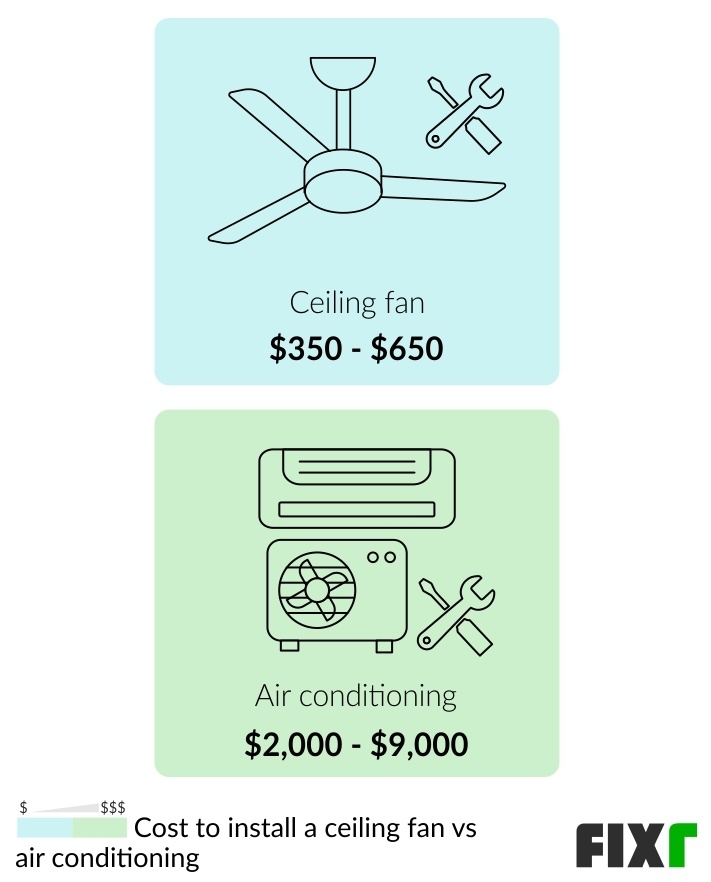
| Device | Boilerplate Cost (Installed) |
|---|---|
| Ceiling Fan | $350 - $650 |
| Air-conditioning | $2,000 - $9,000 |
Enhancement and Improvement Costs
Covers
Ceiling fan covers are a recent trend where the blades of a fan are covered to change the fan's appearance. Covers are commonly crafted in youth or children's designs and colors. They are relatively piece of cake to install and remove and offering an excellent way to protect the fan from aging from the sun. Covers toll betwixt $xx and $60.
Thermostat
Permit your fan work in tandem with your HVAC system past installing a ceiling fan thermostat where the fan turns on or off at designated temperatures. You save money on cooling by engaging your fan before your Ac is scheduled to switch on. Ceiling fan thermostats usually cost between $20 and $100.
Remote Control Ceiling Fan Toll
Controlling your fan with a remote is more convenient than getting upwards and flipping a wall switch or pulling a cable every time you want to change your fan's settings. Remote controls also make installation easier because you lot do not demand a separate powered wall switch. Fans with remote controls cost $150 to $one,000.
Ceiling Fan With Retractable Blades
Retractable blade ceiling fans pull their blades in toward the eye when they are non in motion. They crave less maintenance than traditional fans and offer quieter performance. Some homeowners may likewise appreciate the aesthetics of fans with retractable blades. Yous pay between $200 and $800 for a retractable blade ceiling fan.
Additional Considerations and Costs
- Permits. Y'all may demand a permit to install a new fan in a location without existing wiring. Building codes for ceiling fans normally crave that ceilings are at to the lowest degree 7 feet. There are frequently restrictions on fan installation for homes with low ceilings, so it is of import to talk to your contractor to see whether your ceiling is high plenty for fan installation.
- Fan speed. Today, most fans feature 3 speeds, but some offer variable speeds that you lot gear up with a punch controller or a remote. Your electrician can add a speed controller to an existing fan to requite information technology multi-speed functionality.
- Domicile value. Ceiling fans are a welcome convenience, and their presence, should yous decide to sell your home, may help a buyer grade a good impression most your home.
- DIY. Replacing and installing a ceiling fan is a technical process best performed past a handyman with electrical experience or a licensed electrician because y'all are working with live wires and an electrified device.
- Fan motor. Your fan's motor runs on alternate current (AC) or straight current (DC). AC motors have been used for longer than DC motors. They use 70% less energy than Air-conditioning motors and are quieter. DC fans are more than expensive, with price increases of 200%. AC units are cheaper and provide a more consequent airflow than DC units.
- Security. You may consider installing actress hardware on your fan to create a more secure running fan. This gives you peace of mind when you take a fan in a child's room and want to exit the fan on overnight.
- Fan removal. Your electrician or handyman tin can completely remove a fan and make certain there are no live wires that could cause a trouble. The area might crave drywall patching, or the electrician can install a blank plate over the hole.
- Reverse style. Near all fans have a reverse setting for enhanced climate control. Run your fan clockwise in the winter to feel warmer and counter-clockwise in the summer to feel libation. The change in the direction of the blades forces air to travel up or downward and creates a more efficient surround for your HVAC system. Plus, you exercise not need to pay extra for contrary manner since it is included on most all ceiling fans.
FAQs
- How much does it toll to accept someone install a ceiling fan?
The cost for a ceiling fan installation is going to range based on the type of fan being installed and whether there was a fan previously installed. The average toll of installation of a ceiling fan is $398.
- Practice you need an electrician to install a ceiling fan?
It is recommended that a licensed electrician install a ceiling fan. The installation process requires directly working with the dwelling house's wiring. This can exist dangerous when handled by anyone other than a trained professional
- Can I install a ceiling fan where a light fixture is?
A ceiling fan can be installed in the place of a light fixture, though there is a chance that additional materials will be needed to complete the installation. If there is no connection for a light fixture, expect the cost to be about $180 to $320 merely for the labor.
- Are ceiling fans outdated?
Ceiling fans are non necessarily outdated. They are a highly applied in-home choice that reduces free energy costs and supports a more comfortable lifestyle by keeping the home cool.
- How long does it take to install a ceiling fan?
The length of fourth dimension necessary to install a ceiling fan varies depending on the complexity of the fan's installation process and whether or not the wiring is in place or non prior to the installation process. The procedure takes betwixt one and 3 hours.
- How long does a ceiling fan final?
Fans are generally manufactured to last at least ten years, even if yous employ the fan every day and for many hours each day. Repairs and service calls can help make your fan last longer. Still, information technology is important to keep an centre on costs because some repairs are as expensive equally new fans.

Source: https://www.fixr.com/costs/ceiling-fan-installation
Posted by: wilderuppoorning.blogspot.com
0 Response to "How Much Will It Cost To Install A Ceiling Fan"
Post a Comment