

XFX Radeon RX 5700 XT Thicc II Ultra review: A high-performance muscle car of a GPU - wilderuppoorning
At a Peek
Expert's Rating
Pros
- Excellent gaming performance
- Stunningly gorgeous design
- Untold tank and quieter than reference designs
- Plural-BIOS switch
- Lackadaisical fan stop feature for silent desktop use
- PCIe 4.0 compatible
Cons
- Launch batch needs BIOS update
- Slightly louder than other custom options
- Really high power consumption
- No existent-time beam of light tracing capabilities
Our Verdict
The gorgeous XFX Radeon RX 5700 XT Thicc Two Extremist is like a muscle car: Drunk playacting, a weensy flash, extremely impressive, and in require of some little tinkering for peak performance.
Best Prices Nowadays

$450
Gamers, start your engines. The $440 XFX Radeon RX 5700 XT Thicc II Immoderate is the first custom Radeon RX 5700 XT graphics card we've set hands on, and information technology screams.
The Thicc II Extremist evokes XFX's beloved Double Wastefulness design, with an ultra-clean, black-and-chrome strategy reminiscent of American heftines cars, and revved-up clock speeds to match. Like whatsoever hot-rod, though, you'll need to tinker with it a bit for the second-best carrying into action, and you can hear information technology purring when you arrange the pedal to the gaming metal.
It's worth it. The XFX Radeon RX 5700 XT Thicc II Immoderate is extremely magnificent and exceedingly fast, ambitious AMD's original flagship GPU intimately past the similarly priced GeForce RTX 2060 Super's performance. With its optimizations, the Thicc II Immoderate inches awfully just about the $500 RTX 2070 Super's couc rates. You'll be able to find it at retailers this week, only XFX sent us an early review sample distribution to test. Lashkar-e-Tayyiba's get to it.
XFX Radeon RX 5700 XT Thicc II Ultra: Specs and features
XFX's graphics circuit card puts an overclocked, custom-cooled spin on AMD's Radeon RX 5700 XT's "Navi" GPU.
This generation's Navi chips are chock full of cutting-edge features. They're the 1st consumer GPUs built using the 7nm manufacturing process, the initiative GPUs to support the ultra-fast PCIe 4.0 interface (if you pair it with a Ryzen 3000 CPU and an X570 motherboard), and the number one GPUs created with AMD's untested underlying "RDNA" graphics computer architecture. The combining of RDNA and 7nm greatly landscaped the power efficiency of Radeon GPUs, and the RX 5700 series performs much finer in games that used to strongly favor Nvidia's GeForce graphics card game. AMD also introduced helpful software tricks like Radeon Image Sharpening to supporte stimulate punter carrying into action out of your hardware, though Navi does not support rattling-time ray trace like the GeForce RTX 20-series.
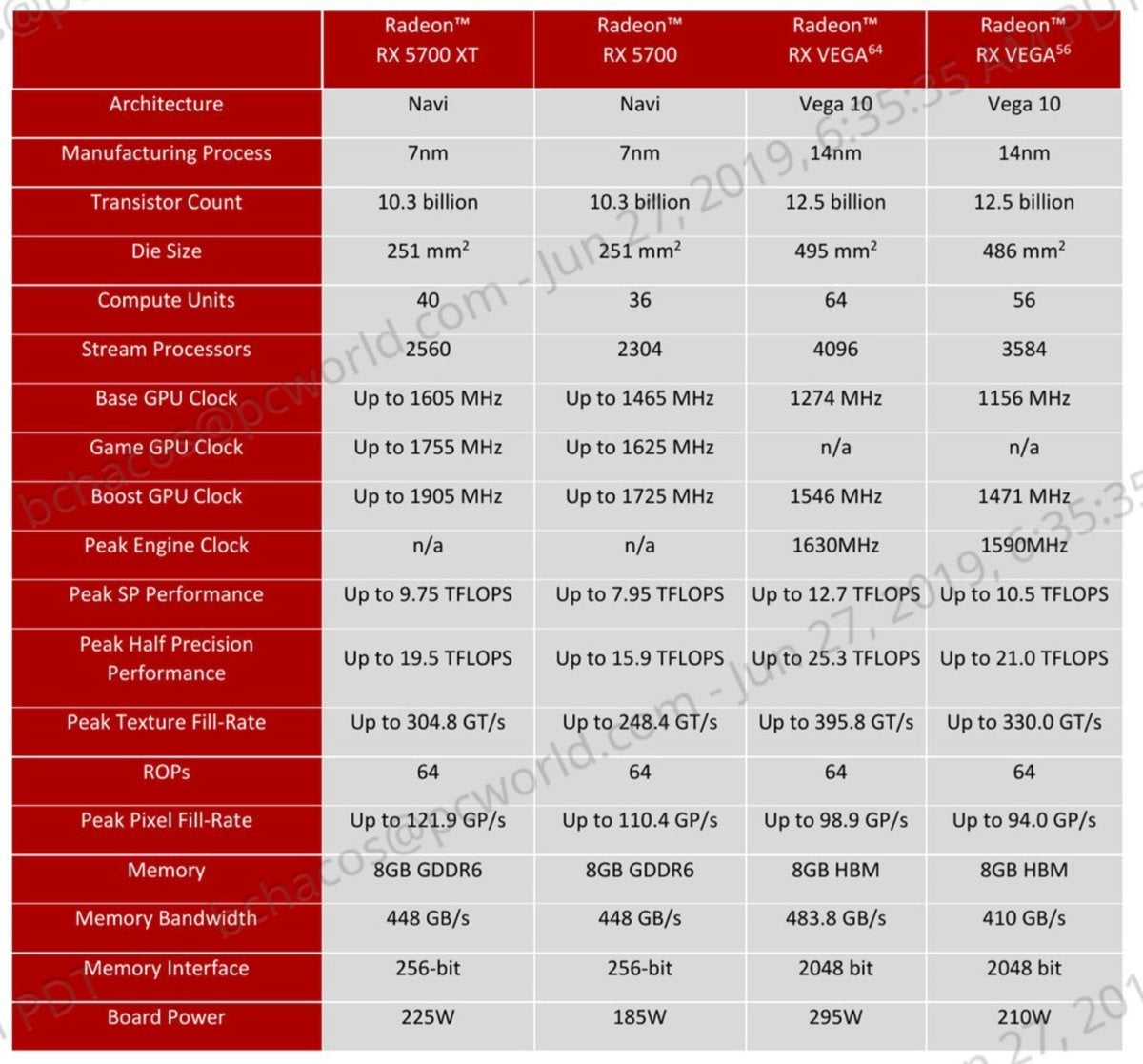
Look into our Radeon RX 5700 and 5700 XT review for the engorged recap. This review will focus on the XFX Radeon RX 5700 XT Thicc Cardinal Ultra's tweaks and performance. Here's a reckon at the line of descent specifications for the Radeon RX 5700 serial publication compared to last-generation's Radeon Vega GPUs to get you up to hie:
 AMD
AMD XFX ups the ante by increasing the base time to 1,730MHz, the game clock to 1,870MHz, and the cost increase time to 1,980MHz—at least theoretically. In practice session, we discovered the Thicc II Ultra hovering closer to the full-blown boost speed in most games, Eastern Samoa opposed to the game clock it's awaited to achieve in typical gaming scenarios. In just about scenarios and scenes, it even topped 2,000MHz—no joke. Pushing Navi so challenging requires much more power than the Radeon RX 5700 XT reference work bill of fare, as you'll see later in our limited review.
Information technology also requires a to a greater extent substantial cooler.
 XFX
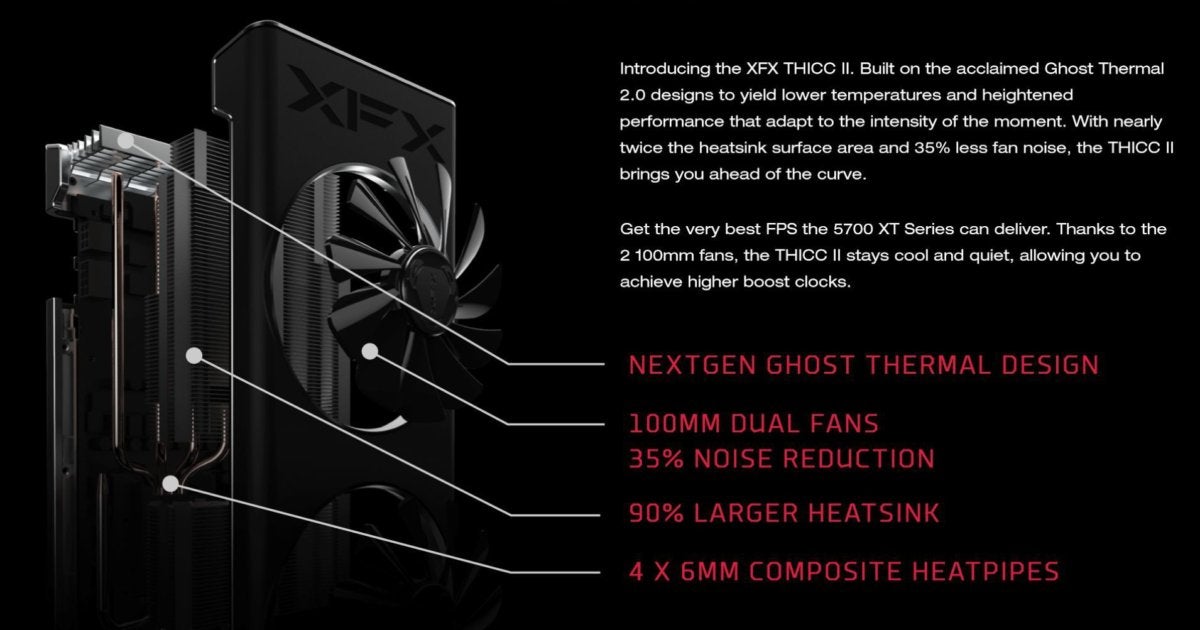
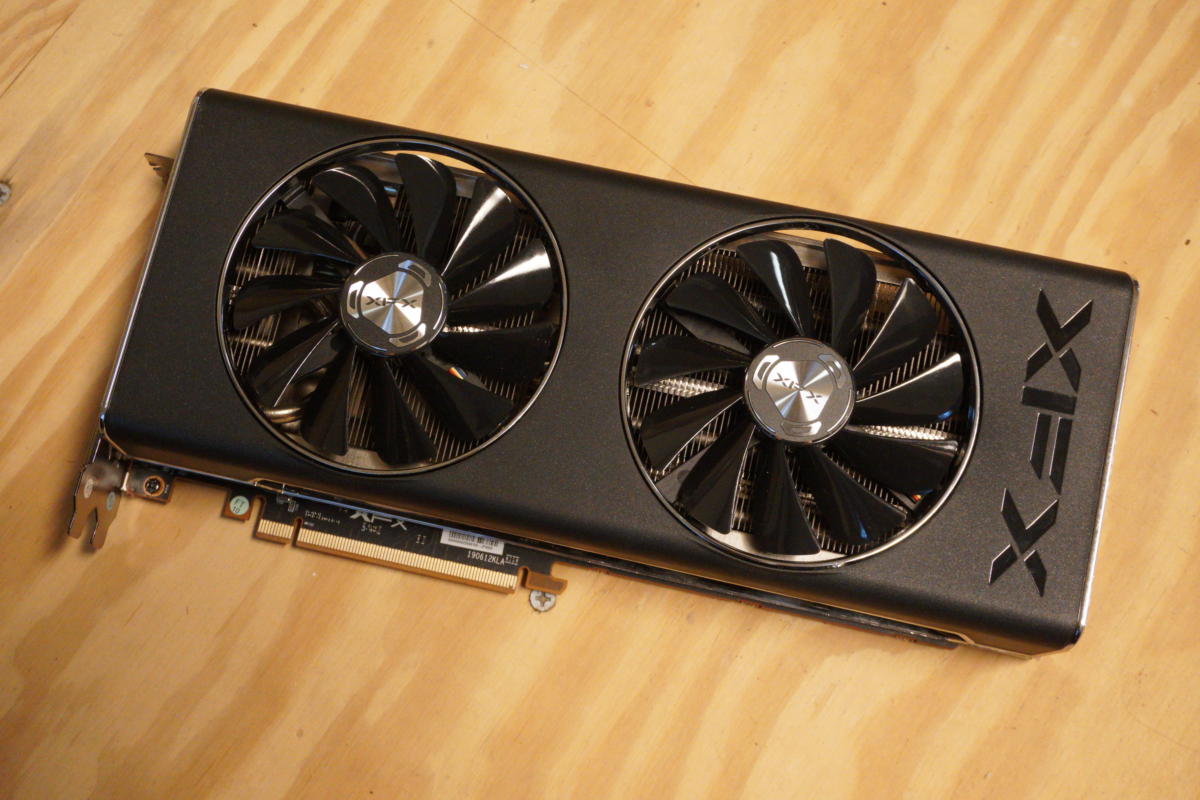
XFX The XFX Radeon RX 5700 XT Thicc Deuce Ultra uses the company's "Shade Thermal 2.0" design, which sets a twain of large 100mm fans over a thick heatsink bristling with four 6mm composite heating pipes. The fans include idle stop functionality, so they South Korean won't chip in until you set out the GPU under load. It's unarticulate during normal background use.
A unshared HDMI 2.0b link and a tierce of DisplayPorts make up the end product selection. The 2.5-slot nontextual matter card measures 11.5 inches long, sol IT's not small by hook or by crook, though it International Relations and Security Network't American Samoa unreasonably big equally some fully kitted-out custom GPUs. Musculus cars aren't small.
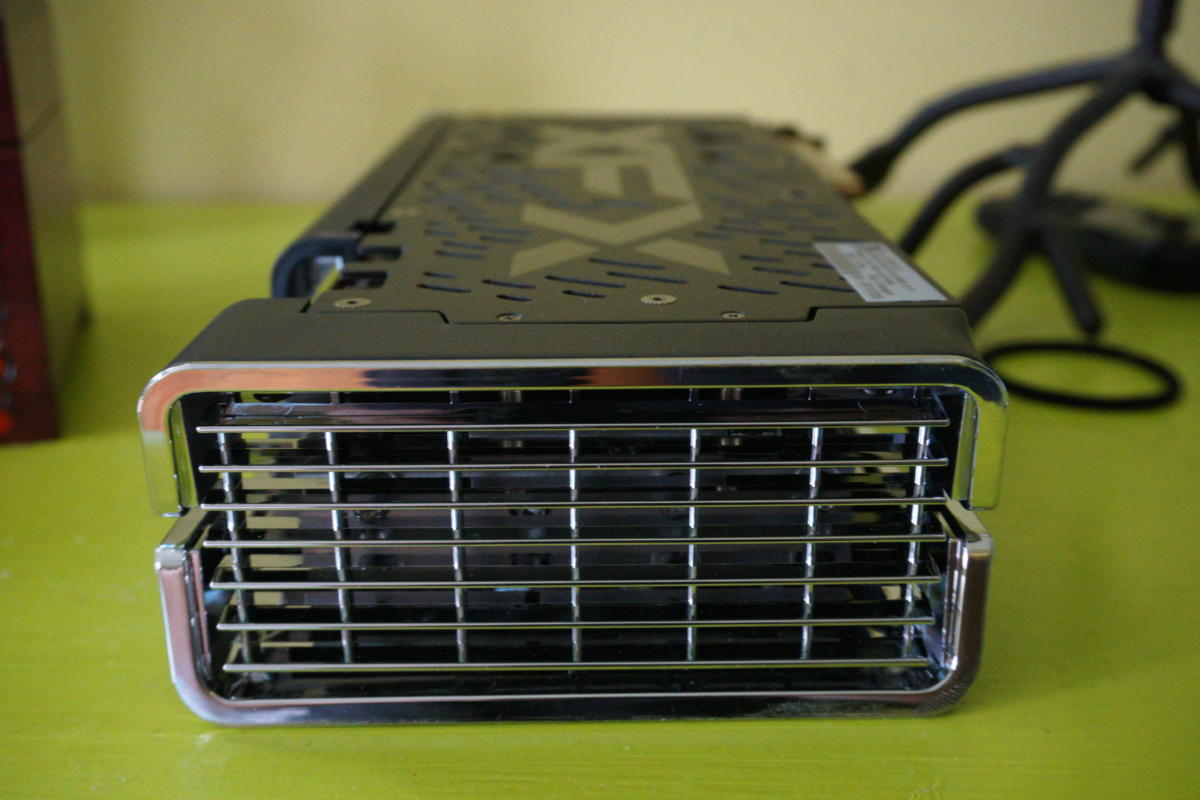
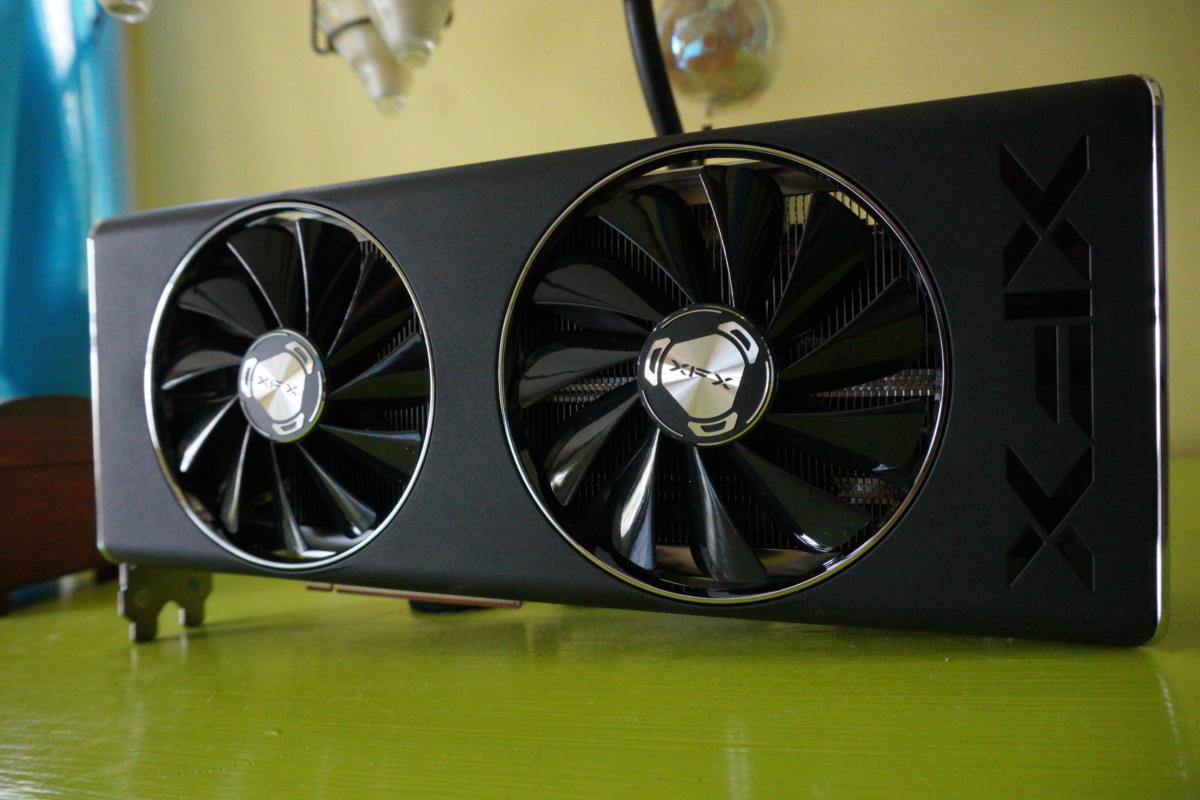
But they are gorgeous. Taste is subjective, but I was always an admirer of the original Large Dissipation design, and the XFX Radeon RX 5700 XT Thicc II Ultra is one of the most pleasant nontextual matter cards I've ever laid eyes on. The card's rocking an ultra-uninfected, ultra-solid-looking black vibe with chrome accents, leaving til now as to outfit the end of the card with a chrome grille that enhances the roadster look.
 Brad Chacos/IDG
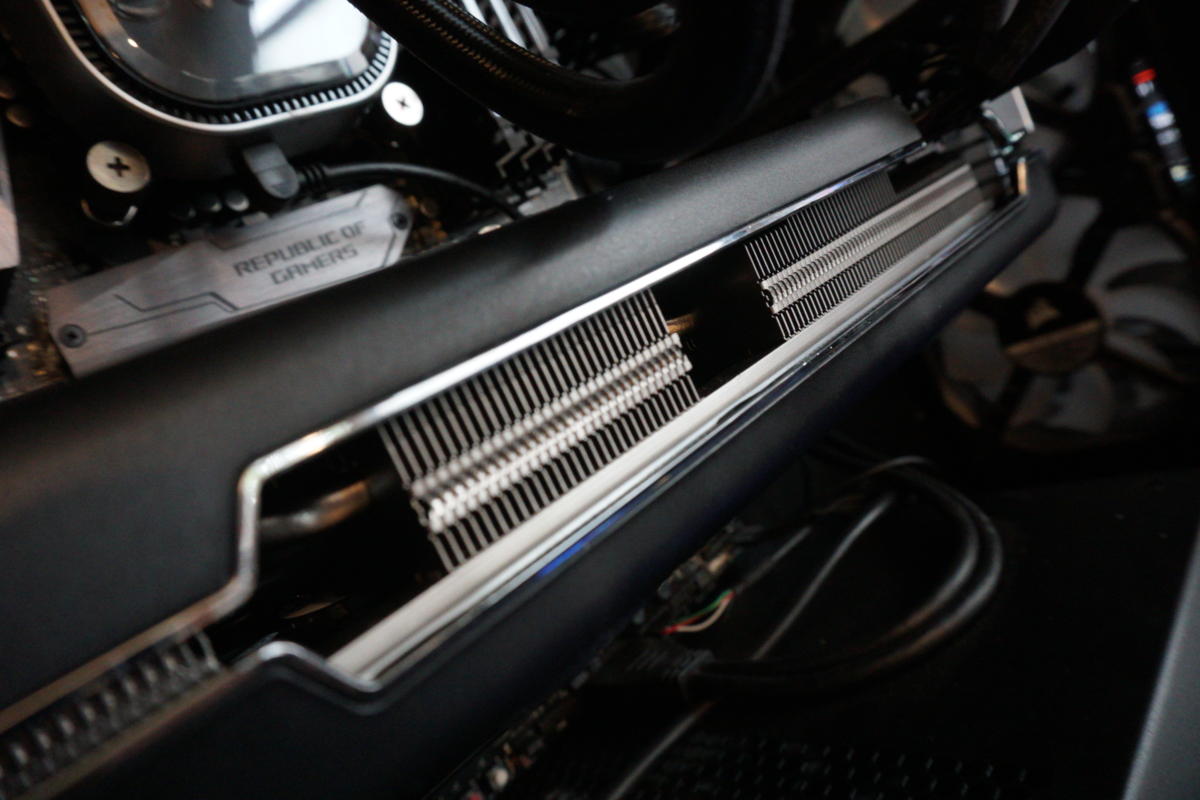
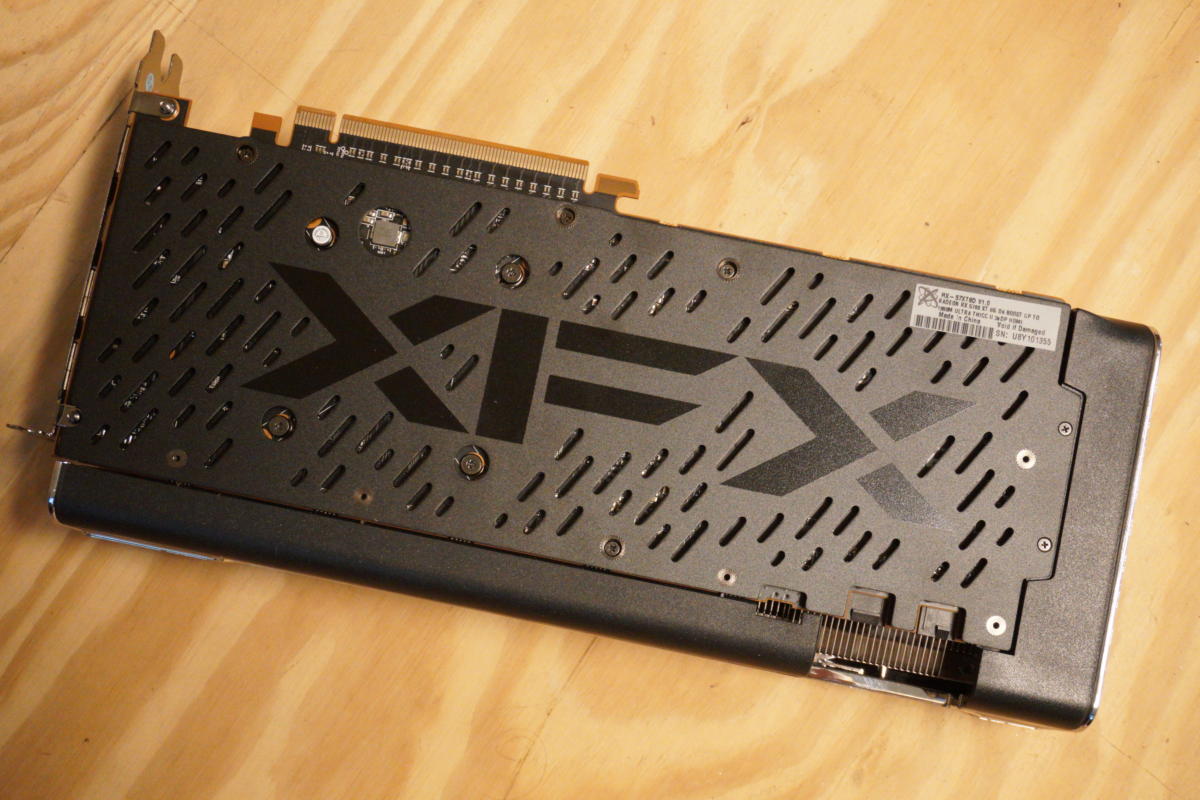
 The black plastic pall wraps the edge of the card, providing a glimpse at the aluminum heatsink underneath, spell a metal backplate with the XFX logo on the top of the bill completes the stark, hard-line tone. You won't find any RGB firing on this graphics card, though a pair of blue LEDs indicate that you've plugged the 6-pin and 8-pin power connectors correctly into this 210W GPU.
 Brad Chacos/IDG
 The view from the side. Mmmmm.
I'm in love with the hardware. But keeping with the muscle gondola analogy, you need to pluck and tune things to get it running properly—at to the lowest degree if you pick leading some of the foremost Thicc II Ultra cards to hit the streets.
Succeeding page: Whatever necessary tinkering
Tinkering under the hood: Temporary fan swiftness woes
Our reexamine sample shipped with a misbehaving primary Performance BIOS. The first undulation of Thicc II Ultra cards to hit store shelves will let the same problem too. Fortunately, on that point's already a fix available, which we used for this review.
The problems rotated around fan speeds and the slothful devotee diaphragm have. KO'd of the box seat, logging software half-tracked the Thicc II Ultra's fans as spinning at over 65,000 rotations per minute (rpm). That's horrific, Eastern Samoa graphics card fans normally run at 2,500 rpm. More outrageous? The software listed those fan speeds while the fans themselves were seated idle, not spinning the least bit. Something was understandably wrong Here.
 Brad Chacos/IDG
 That problem became exacerbated once we booted up about games. Because the software according the fans as already running at ludicrous speeds, they didn't really kick in until the CORE GPU temperature hit a toasty 100 degrees Celsius. That's scorching hot—literally, if you touch the backplate—and it causes severe strangling for a minute or cardinal later you boot up a game, at which point the fans chip in at a screaming-fortissimo 3,200+revolutions per minute ahead slowly throttling down to 2,100rpm o'er the course of a precise noisy few minutes.
Under these conditions, the card drew fantastic amounts of power. Our entire system sucked down as much energy low lode as the monstrous $1,200 GeForce RTX 2080 Ti, in fact.
Steve Walton over at the excellent YouTube channel Computer hardware Unboxed also received the Thicc II Ultra in for examination, and he reviewed the bill using the as-shipped "loud" Performance BIOS. You can see him discourse the lover speed issues starting at the 5:25 mark in the video below. Steve says the noise levels settle down later on about six minutes, and won't pop up again if you continue gaming for a long adulterate. However, it rears its head again whenever you freight the GPU after the fans have sat idle for a spell (a.k.a. standard desktop usance).
It's a shame that this occurs, because the Thicc II Ultra is otherwise an salient graphics card. Echoing Steve, this behavior ISN't good. XFX says it may be a pester with AMD's Powerplay tables causation the issues. That said, you have ways to fix it if you run into the selfsame problem.
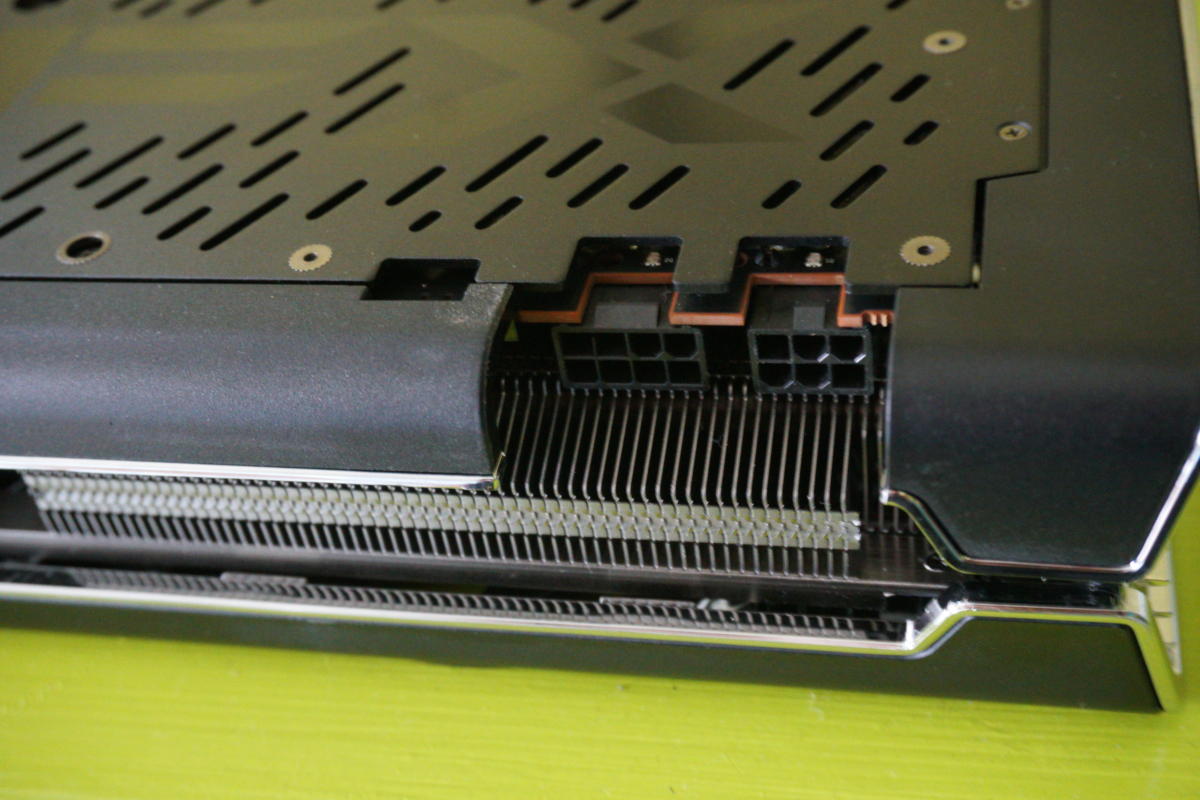
First, this card ships with a dual-BIOS switch that swaps between Performance and Quiet BIOS, set to Performance aside default. That's the troublesome BIOS. If you exchange to Quiet—you'll pauperism to enjoyment a pen or something to reach internal the pall's cut-out to do soh—the card behaves as expected. The Quiet BIOS cranks time speeds down somewhat, however, to the performance level of the $420 XFX Thicc II non-Ultra, so you're going an excess $20's worth of potential speed along the table. To be veracious, though, the Quiet BIOS International Relations and Security Network't that a great deal slower operating room quieter than the firsthand Public presentation BIOS.
 Brad Chacos/IDG
 The physical BIOS switch is in the little cut-out to the left of the power connectors.
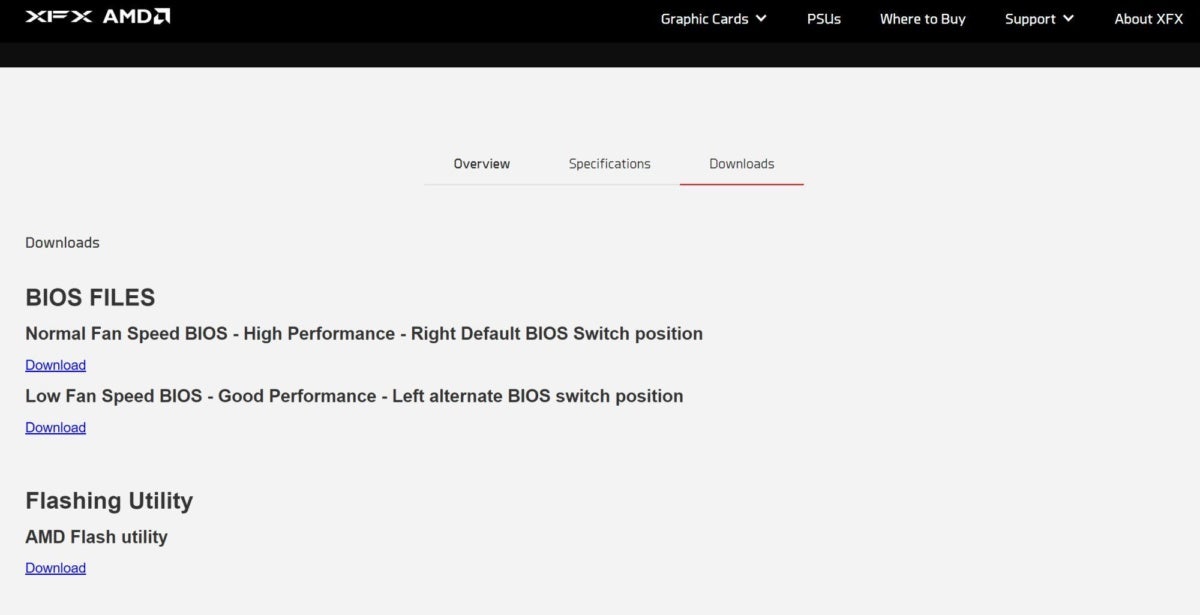
As an alternative, XFX already has a fixed Performance BIOS procurable, which you could easily establis onto your graphics card using the plain and straightforward ATI Flash utility. It's a hassle, merely it takes but a few minutes, and it bequeath greatly improve your experience with this graphics card. We urge installation the new BIOS from XFX's website if you purchase this graphics notice. You can already find it in the Downloads surgical incision happening the Radeon RX 5700 XT Thicc II Ultra page.
 XFX
XFX You want "Normal Fan Speed BIOS – High-level Performance – Right Default BIOS Switch placement" if your card exhibits troublesome behavior verboten of the box. Make sure the physical BIOS electrical switch is in the correct position before installing IT.
In store shipments bequeath have the fixed BIOS practical stunned of the boxful, so the headaches described therein section should use only to very early adopters. IT's a pain, merely get into't let it turning you off of an other than fantabulous piece of ironware, peculiarly if you're reading this well aft the card's untimely September launch.
Our look back was conducted using the sunrise BIOS; refer to the Ironware Unboxed video above if you wishing to see default out-of-the-box functioning for the XFX Radeon RX 5700 XT Thicc II Ultra. I can't help but wonder if something AMD did behind the scenes with its drivers altered the behavior of custom profiles, as Gamers Link also noted bizarre fan belt along conduct in its review of the PowerColor Radeon RX 5700 Red Dragon. This issue with the XFX bill of fare seemingly popped up at the in conclusion atomlike, after Radeon Package Adrenalin 19.9.1 released, when it should have been caught during the quality pledge process. Alas.
Whew. That was a drawn-out and extremely extraordinary detail. Onto the trial bench!
Next page: Our test system, benchmarks set out
Our test system
Our dedicated nontextual matter card psychometric test system is packed with some of the fastest additive components available to put any potential performance bottlenecks squarely on the GPU. Most of the computer hardware was provided by the manufacturers, only we purchased the tank and warehousing ourselves.
- Intel Core i7-8700K processor ($350 on Amazon)
- EVGA CLC 240 closed-loop topology clear cooler ($120 happening Amazon)
- Asus Maximus X Hero motherboard ($395 on Virago)
- 64GB HyperX Predator RGB DDR4/2933 ($390 on Amazon)
- EVGA 1200W SuperNova P2 mightiness supply ($320 along Amazon)
- Corsair Crystal 570X RGB case, with front and top panels separate and an extra rear end fan installed for developed airflow ($130 on Amazon)
- 2x 500GB Samsung 860 EVO SSDs ($75 all on Amazon)
We'atomic number 75 comparing the $440 XFX Radeon RX 5700 XT Thicc II Ultra against AMD's $400 reference Radeon RX 5700 XT and its trivial sibling, the $350 RX 5700, as well as the $400 GeForce RTX 2060 Super Founders Edition and the $500 GeForce RTX 2070 Super Variation, its nearest competitors. For a broader view how AMD's core GPU stacks up against other card game, be sure to check unfashionable our original Radeon RX 5700 series review.
All prices cited are launch MSRP. You tooshie oft find cite RX 5700 cards cheaper on the streets these days, while custom RTX Comprehensive GPUs tend to trade for more than the (instantly gone) Founders Edition cards.
 Brad Chacos/IDG
 Each game is proven using its in-game benchmark at the highest possible graphics presets, with VSync, frame rate caps, and totally GPU vendor-specific technologies—look-alike AMD TressFX, Nvidia GameWorks options, and FreeSync/G-Synchronize—disabled, and temporal anti-aliasing (TAA) enabled to push these altitudinous-end cards to their limits. If anything differs from that, we'll observe it. We run each benchmark leastways three multiplication and list the average result for each test. As noted in the premature section, we tested the Thicc II Ultra exploitation the "fixed" Execution BIOS provided by XFX, rather than the wonky profile that shipped with the first wave of shipments.
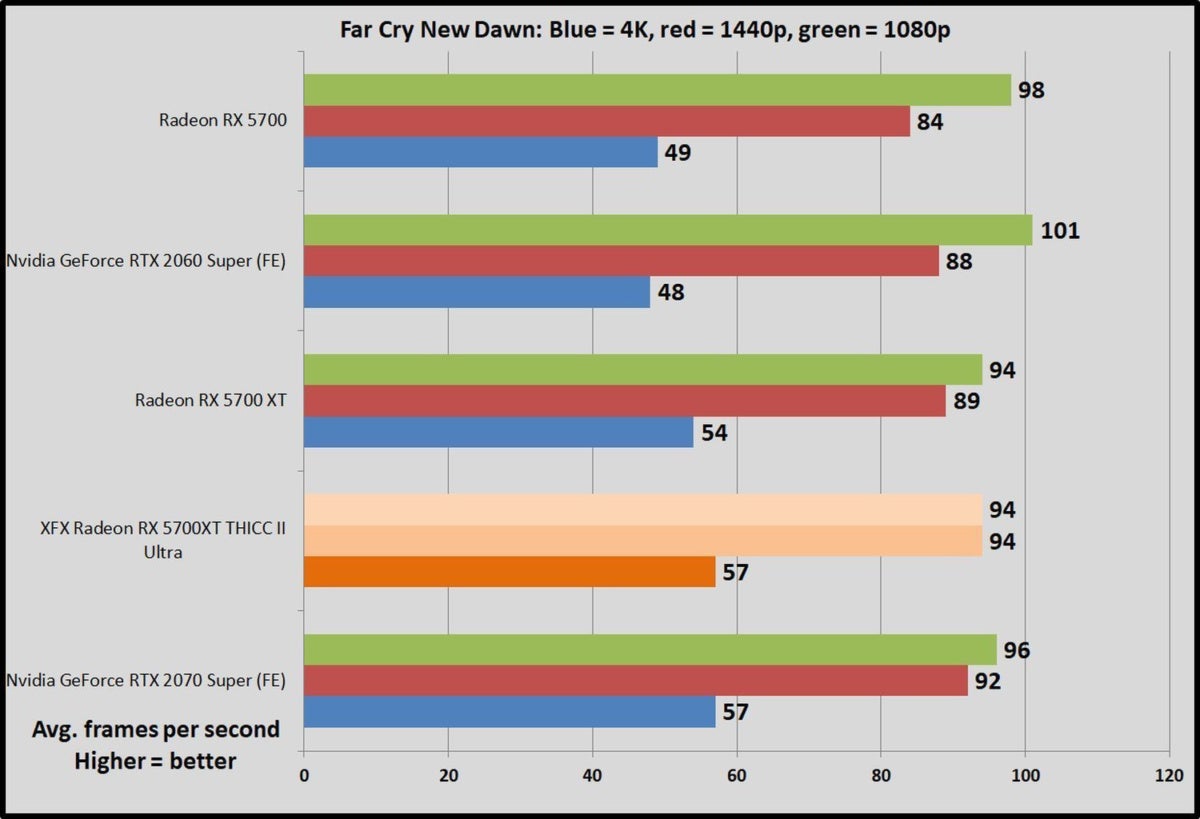
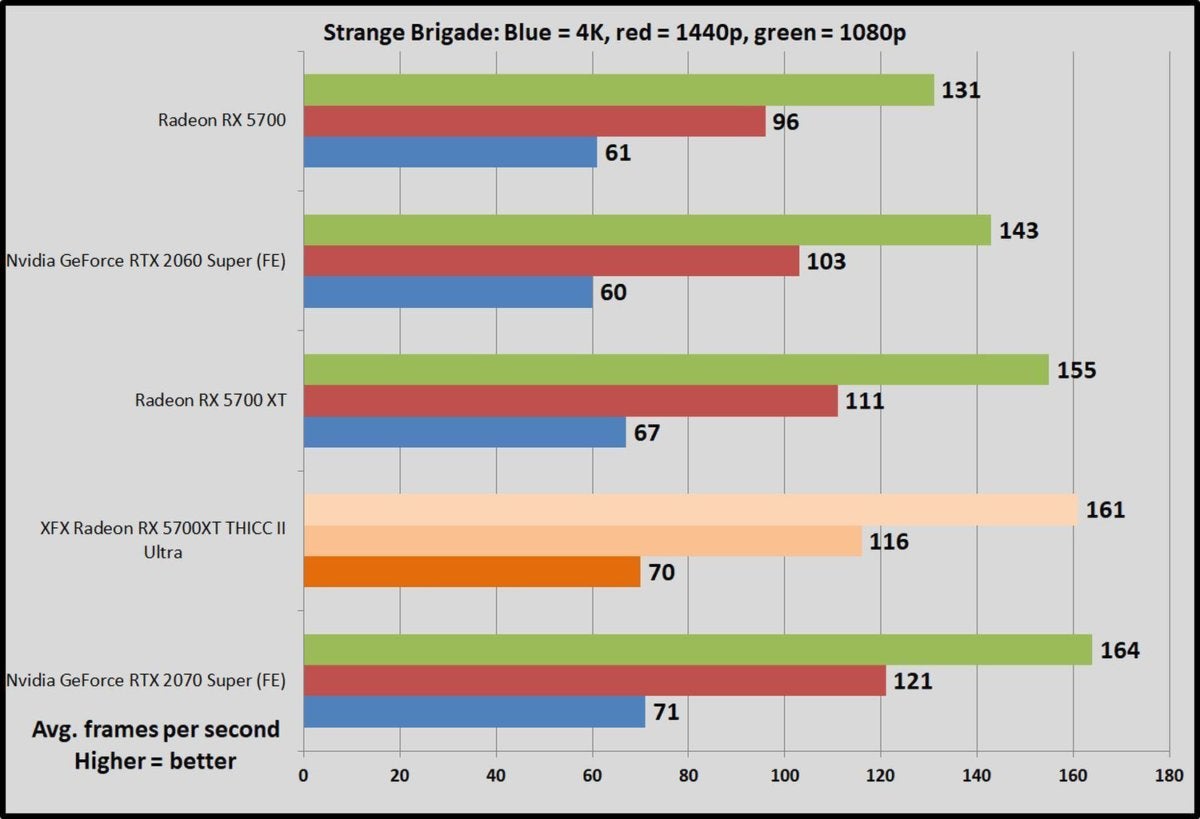
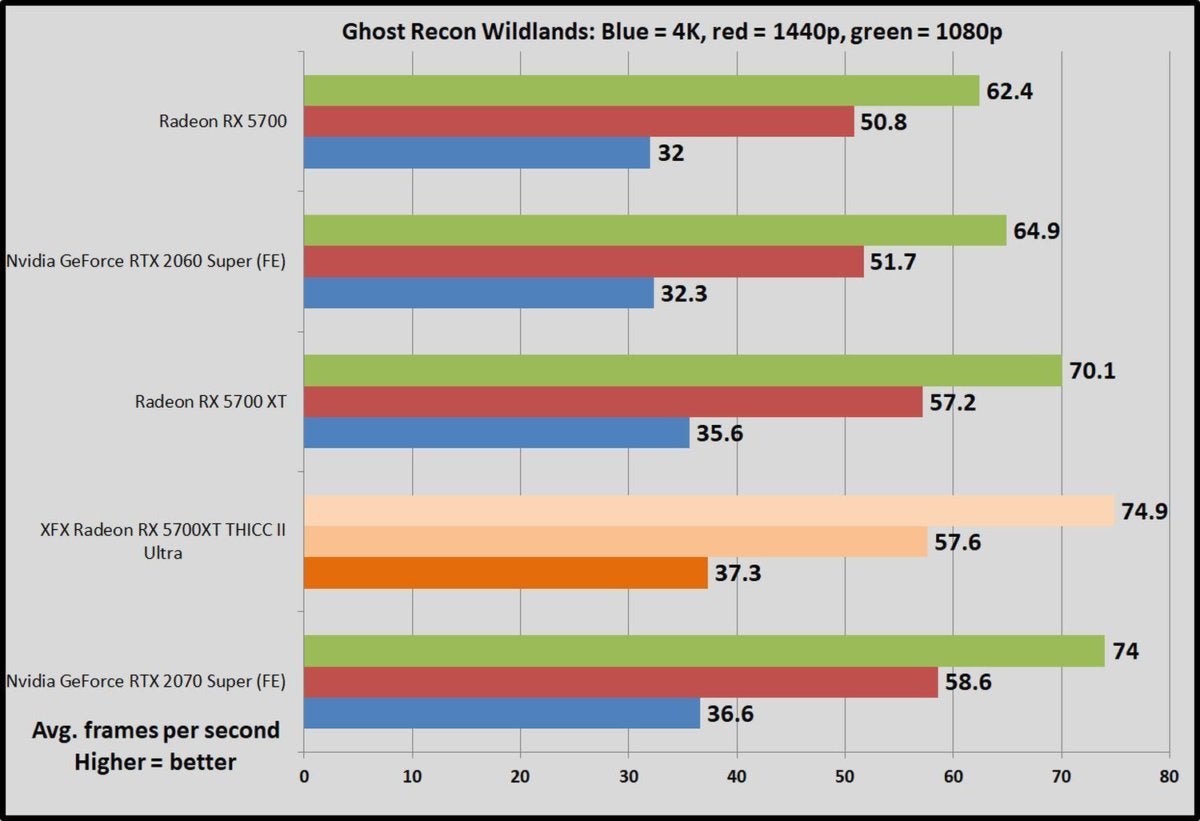
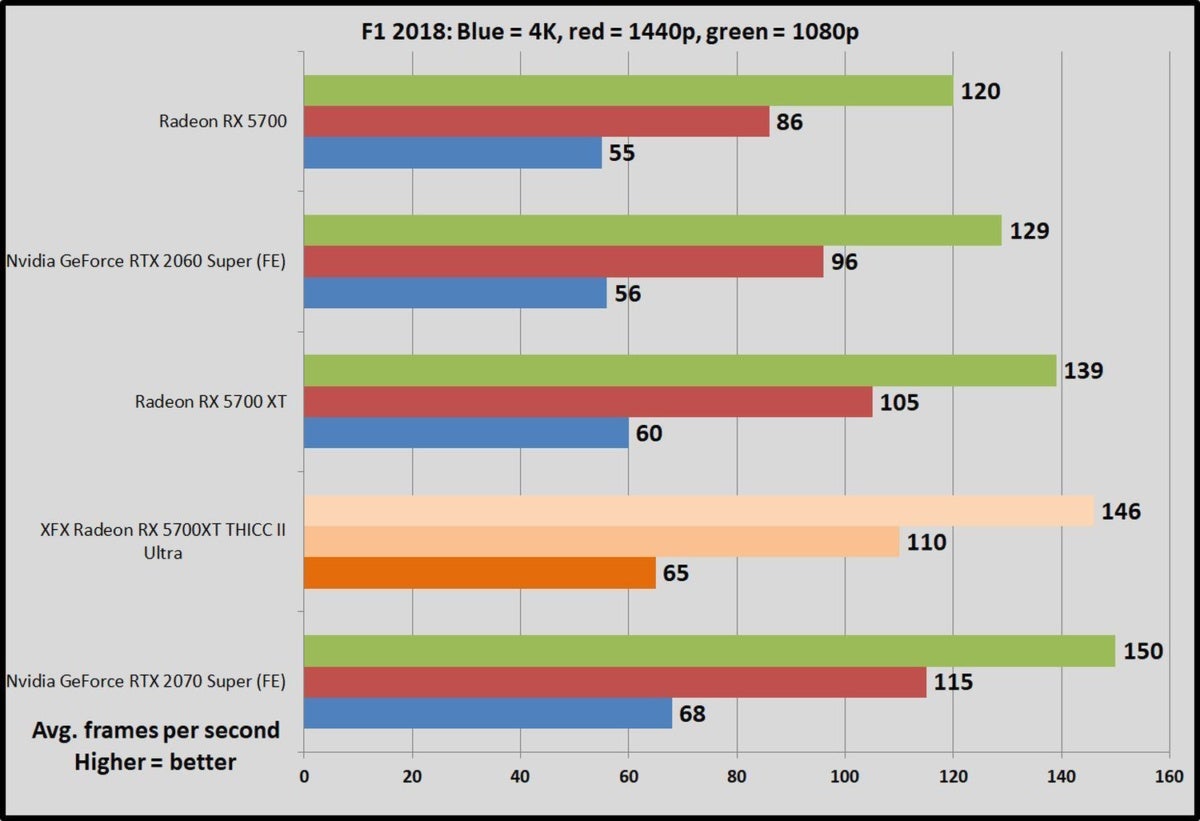
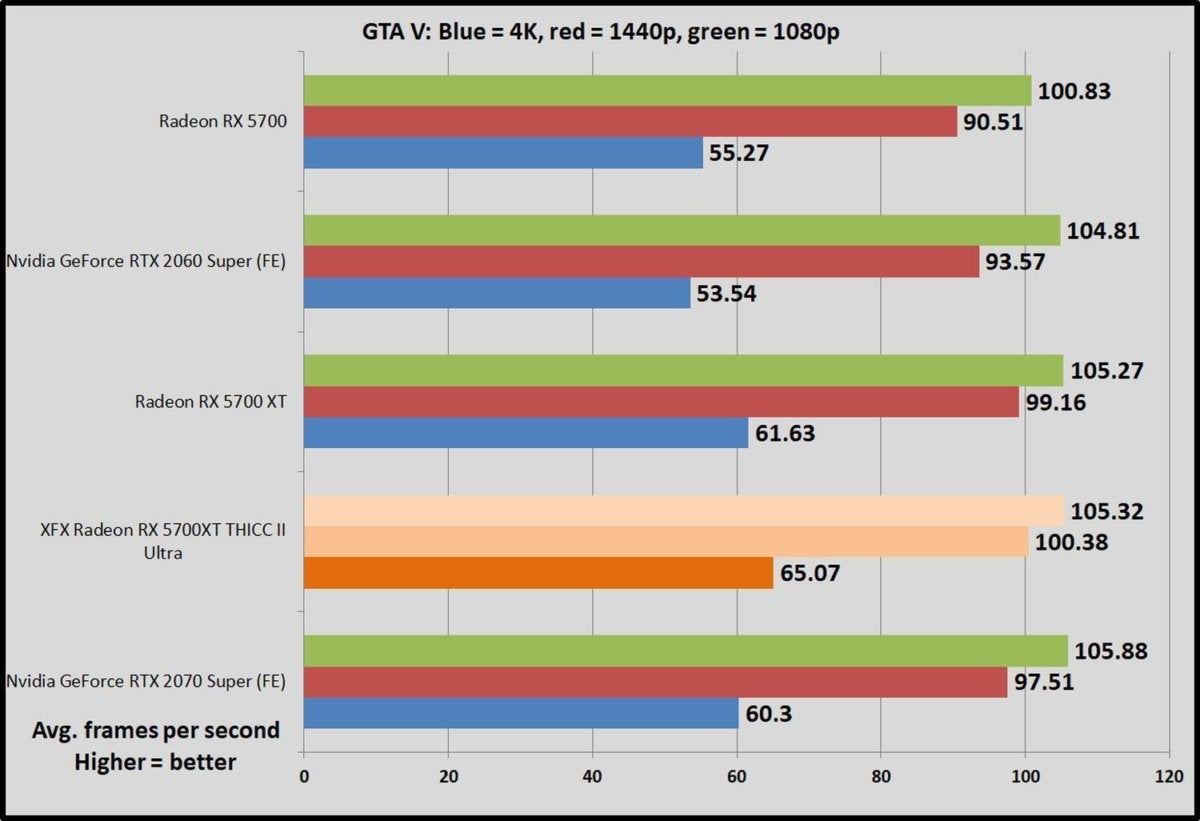
Because the XFX Thicc II Ultra is a faster Radeon RX 5700 XT at its core, we're sledding to skip our usual commentary after each play benchmark and let the testing speak for itself. We'll supply more analysis during the thermal and interference results, and set down a bow on things in our closing recommendations.
Gaming performance benchmarks
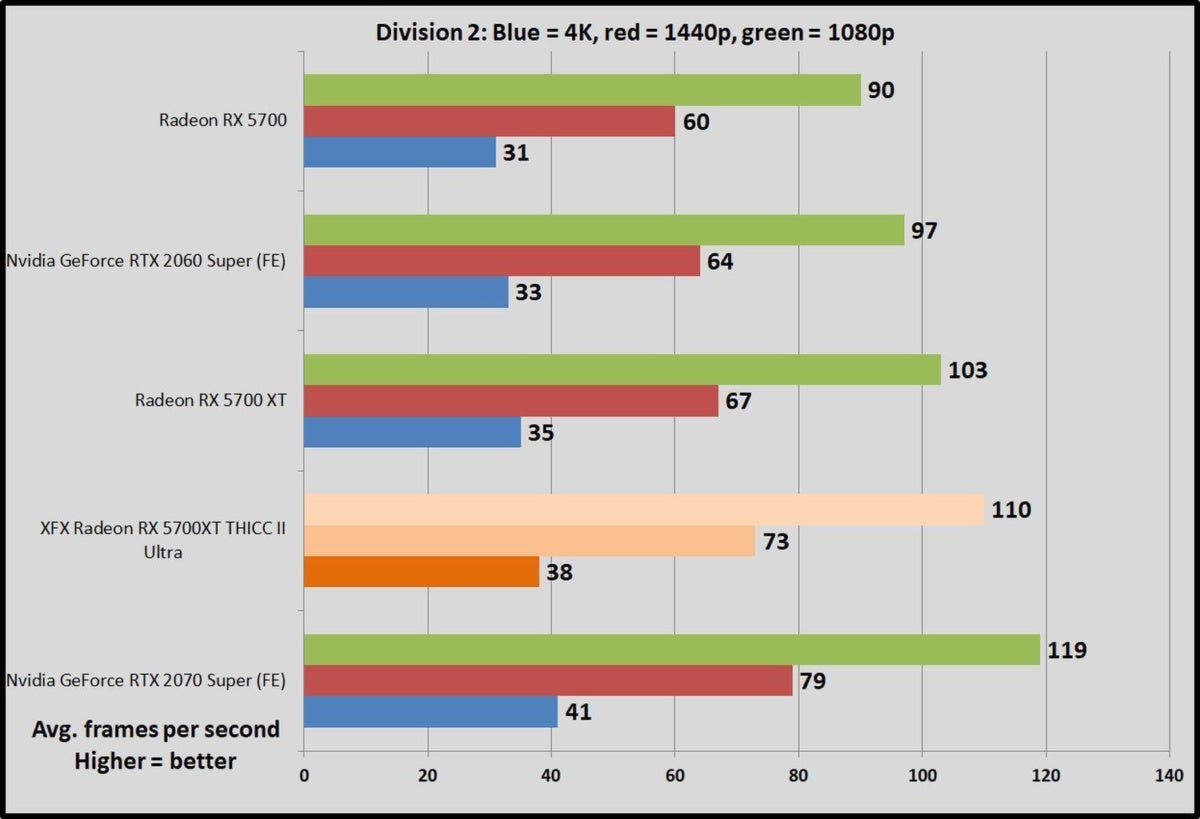
Division 2
Let's start with the latest games. The Division 2 is combined of the best looter-shooters ever created, and the luscious visuals generated by Ubisoft's Snowdrop locomotive engine come through even easier to get hopeless in post-apocalyptic Washington D.C. The collective-in benchmark cycles through quatern "zones" to test an array of environments, and we test with the DirectX 12 renderer enabled. It provides better functioning crossways the board than the DX11 renderer, but requires Windows 10.
 Brad Chacos/IDG
 Far Cry: New Dawn
Some other Ubisoft statute title, Off the beaten track Rallying cry: Unused Dawn drags Far Outcry 5's rattling gameplay into a brand-apocalyptic future of its possess, though this vision is a lot Sir Thomas More orotund—and pink—than The Division 2's bleak setting. The game runs along the latest version of the long-running Dunia locomotive engine, and it's slightly many effortful than Far Blazon out 5's built-in benchmark.
 Brad Chacos/IDG
 Strange Brigade
Strange Brigade ($50 on Chagrin) is a cooperative third-person shooter where a team of adventurers blasts through hordes of mythical enemies. IT's a subject field showcase, well-stacked around the next-gen Vulkan and DirectX 12 technologies and infused with features alike HDR support and the ability to toggle asynchronous compute connected and off. It uses Rebellion's custom Azure engine. We tryout the DX12 renderer with async cipher off.
 Brad Chacos/IDG
 Next page: Gaming benchmarks continue
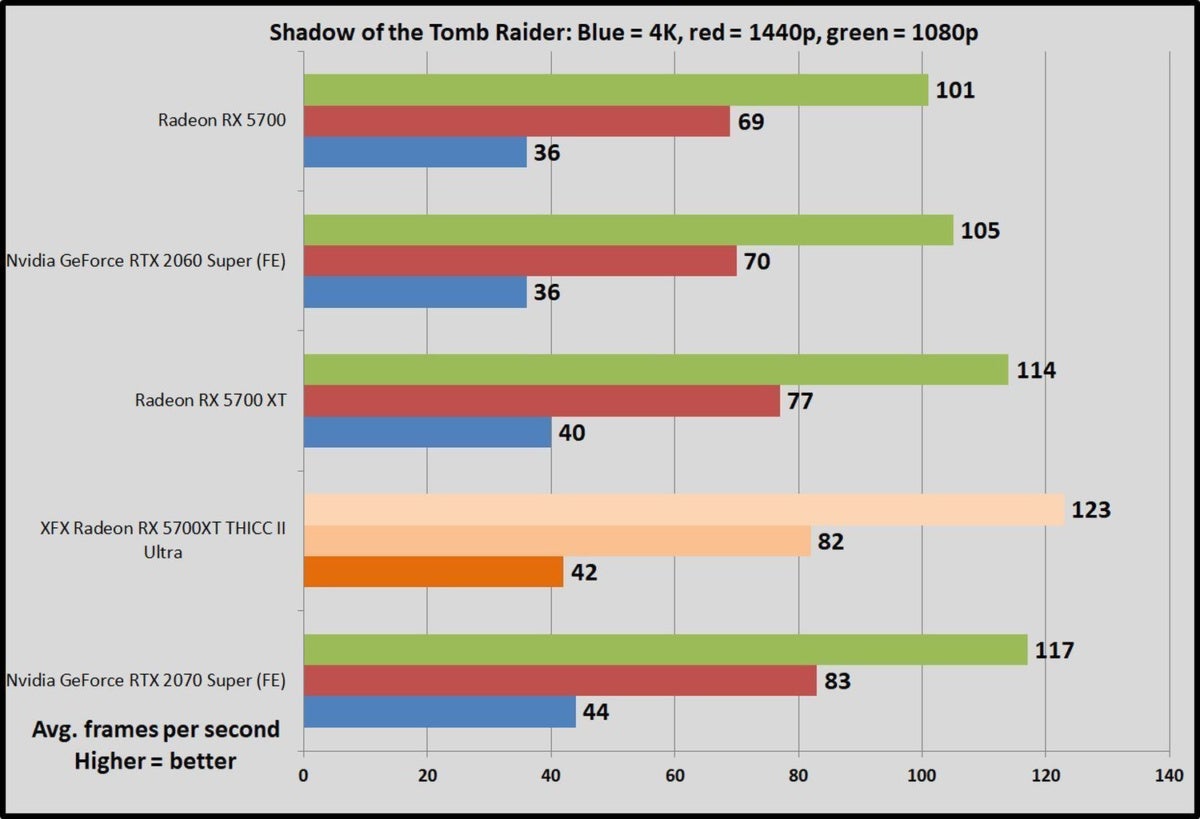
Shadow of the Grave Raider
Phantasm of the Tomb Raider ($60 along Humble) concludes the reboot trilogy, and it's utterlygorgeous. Square Enix optimized this game for DX12, and recommends DX11 only if you're using older hardware or Windows 7, so we test with that.Shadow of the Tomb Raider uses an enhanced version of the Foundation engine that also poweredRaise of the Tomb Raider.
 Brad Chacos/IDG
 Ghost Recon Wildlands
Move concluded,Crysis. If you crank all the graphics options up to 11, like we do for these tests,Wraith Recon Wildlands($50 on Unskilled) and its AnvilNext 2.0 engine utterlymelt GPUs, symmetric with a sequel owed later this year. It's by far the most strenuous courageous in our suite, symmetrical with newer stunners the like Division 2 in the mix. We'll probably swap this out with Ghost Recon Breakpoint when IT launches tardive this year.
 Brad Chacos/IDG
 F1 2018
The latest in a long line of successful games,F1 2018($60 on Humble) is a gem to test, provision a wide of the mark raiment of both visual communication and benchmarking options—devising IT a more than more reliable (and fun) choice than theForzaserial publication. It's built on the fourthly version of Codemasters' buttery-silken Ego game engine. We test two laps on the Australia of course, with clear skies.
 Brad Chacos/IDG
 GTA V
We're going to wrap things up with a bet on that isn't really a visual barn-burner, but still tops the Steam charts all the time. We testExalted Theft Car V ($30 on Humble) with altogether options inside-out to Very Malodorous, all Advanced Art options except extended shadows enabled, and FXAA.GTA Vruns along the RAGE railway locomotive and has received substantial updates since its initial launch.
 Brad Chacos/IDG
 Next page: Synthetics, power, heat
Power delineate, thermals, and noise
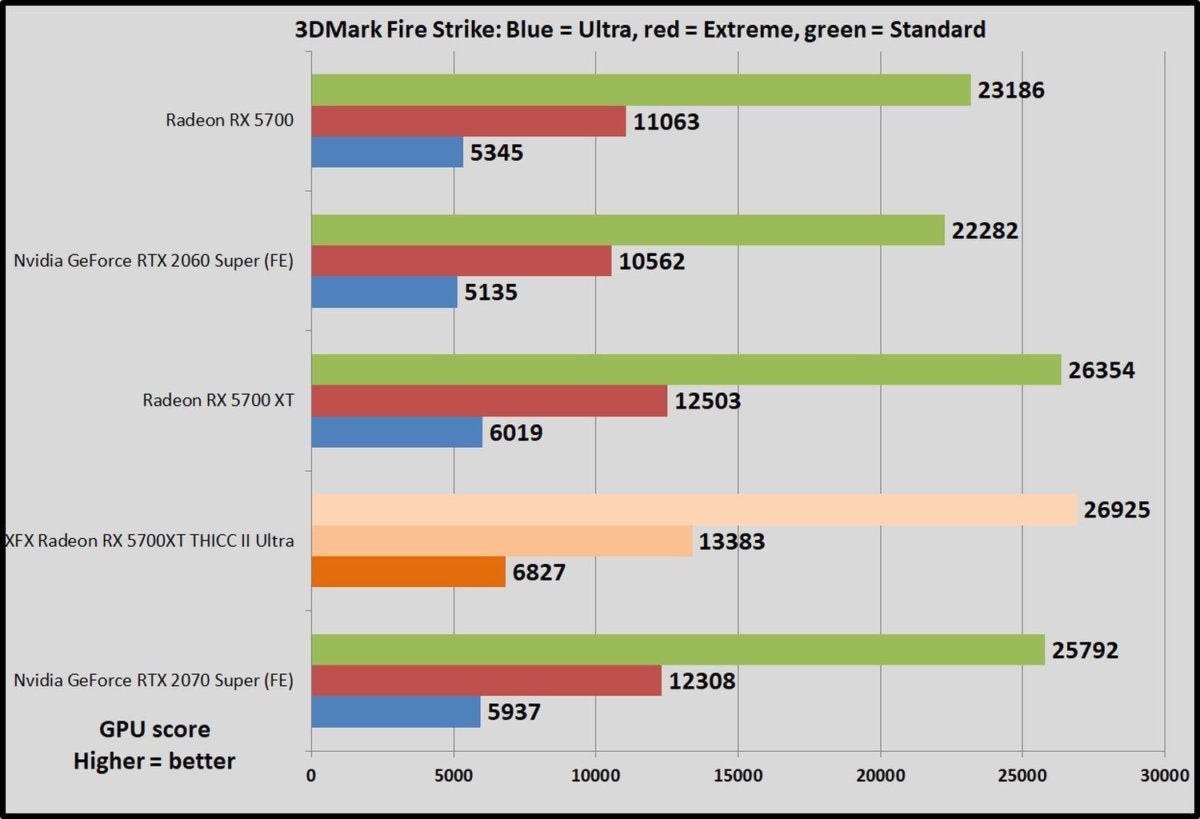
We also tested the XFX Radeon RX 5700 XT Thicc II Ultra using 3DMark's Fire Strike synthetic benchmark. Kindle Strickle runs at 1080p, Kindle Ten-strike Utmost runs at 1440p, and Fire Smasher Ultra runs at 4K resolution. Entirely yield the same scene, only with more intense graphical effects American Samoa you move up the scale, and then that Extreme and Immoderate flavors stress GPUs even more. We record the graphics score to extinguish variance from the CPU.
 Brad Chacos/IDG
 Fire Chance upon public presentation doesn't seem to correlate with real-world games functioning very strongly anymore, as these results would pose IT ahead of the more effective $700 GeForce RTX 2080 Extremely—which it definitely isn't. We'll probably change to some other artificial bench mark soon.
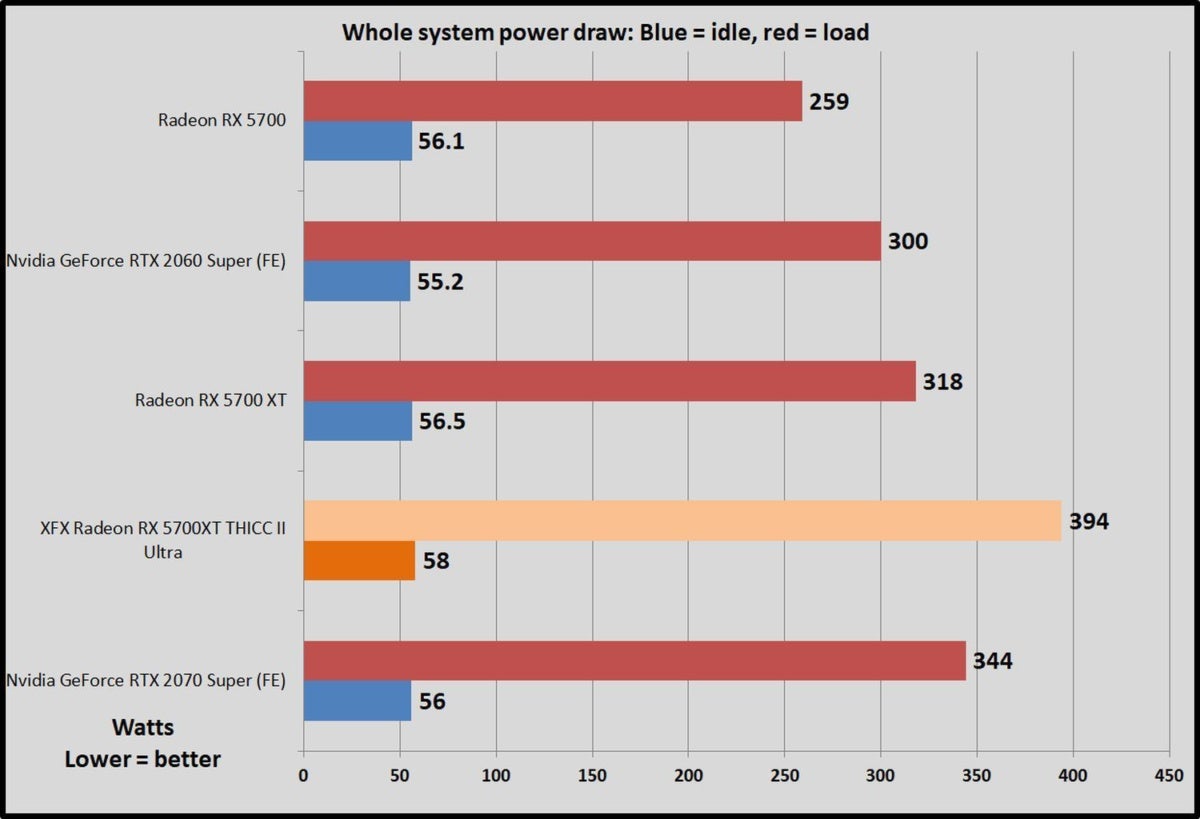
We test power depict aside looping theF1 2018 benchmark for about 20 minutes later on we've benchmarked everything other, and noting the highest reading on our Watts Up Pro meter. The first part of the race, where all competing cars are onscreen simultaneously, tends to Be the most demanding portion.
 Brad Chacos/IDG
 Pushing Navi to such intoxicated clock speeds by all odds stresses its efficiency. Spell the acknowledgment RX 5700 XT delivers vitality efficiency connected a equivalence with, or slenderly better than, Nvidia's competitor RTX GPUs, the ramped-up time speeds in the XFX Thicc Two Ultra suck down a set more baron—even more than the previously mentioned RTX 2080 Super, which is in an entirely different performance class.
And patc the results aren't included here because we used XFX's fixed Performance BIOS, if you try using the as-shipped Carrying into action BIOS with fan speed woes, the power imbibe goes up significantly—to the same levels every bit the monstrous $1,200 GeForce RTX 2080 Ti. Download that new BIOS pronto if you bargain one of the first base wave of this card.
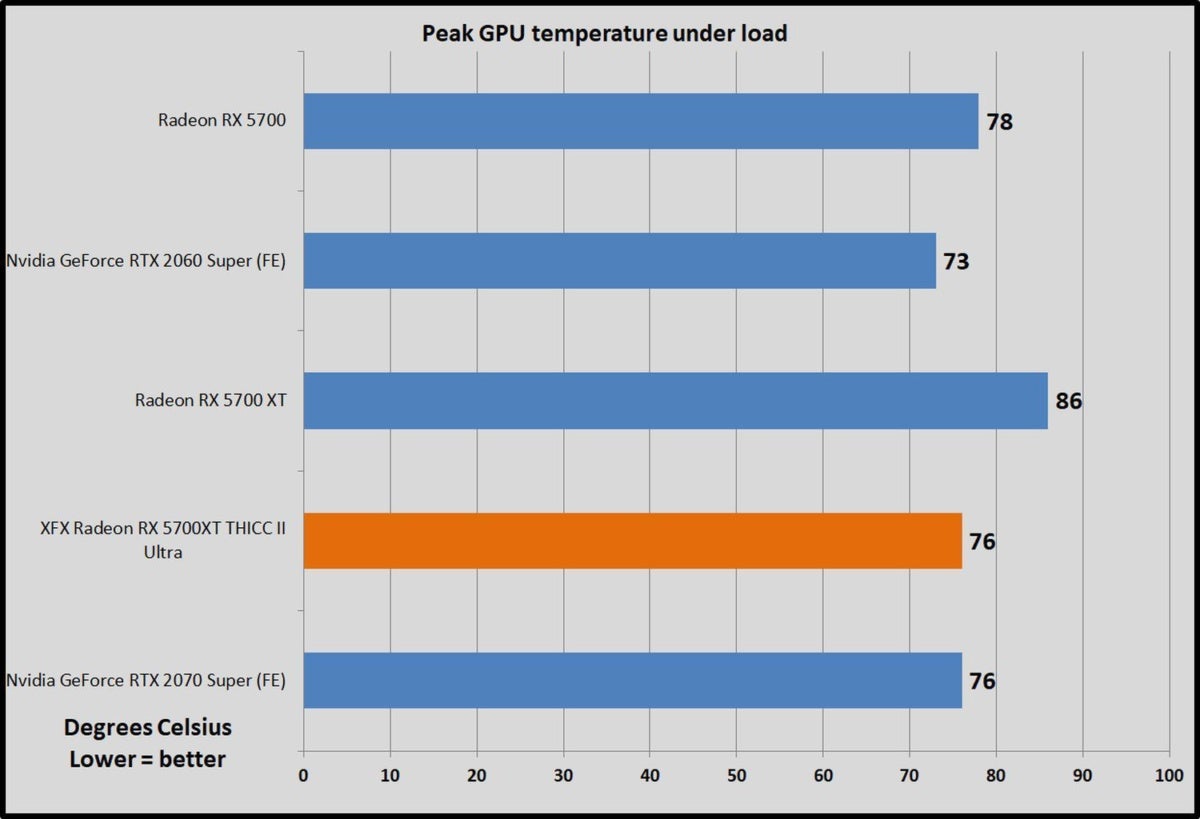
All that said, the 394W this card draws isn't unreasonable, but a side of meat effect of draft that much king is having to dissipate the oestrus. We test thermals by leaving either AMD's Wattman (for Radeon GPUs) or EVGA's Precision X1 (for GeForce GPUs) open during theF1 2018 five-lap power force tryout, noting the highest maximum temperature at the death.
 Brad Chacos/IDG
 XFX's Thicc II Ultra is a lot chillier than AMD's blower-style reference cooler, and subjectively, much quieter as well. But this isn't the quietest card I've ever proven. Even with the fixed Performance BIOS, the fan speeds tend to hover at 2,100rpm to 2,300rpm under load, which is very much quicker than many competing custom designs. It's to be sure needed to keep on the heating system from that malodourous power draw in check, and frankincense allow the Thicc II Immoderate to boost to such high performance levels, but XFX clearly leans toward tank temperatures than lower noise levels.
The card isn't unpleasant to be around though, unlike the notoriously bad Radeon Vega reference coolers. And we really bang the idle fan stop feature (common on high-end custom cards). Absolute silence during standard desktop exercis is delightful.
Incoming page: Should you buy the XFX Radeon RX 5700 XT Thicc II Ultra?
Should you buy the XFX Radeon RX 5700 XT Thicc II Ultra?
It's a shame virtually the plunge batch BIOS woes, simply don't sleep on the XFX Radeon RX 5700 Crosstalk Thicc II Ultra. This is a high-performing, extremely gorgeous graphics card that chews through 1440p gaming or high gear refresh value 1080p gaming without fail.
 Brad Chacos/IDG
 XFX leans hard on AMD's Navi GPU to crank execution. Crosswise our testing suite, the Thicc II Ultra is an average of 4.6 percent faster than the reference RX 5700 XT at 1440p resolution, and tied more so in DirectX 12 games—it's 9 percent faster in Partitioning 2, for example, and 6.5 percent faster in Shadow of the Tomb Raider. It blows past the $400 GeForce RTX 2060 Super and lands within spitting distance of the $500+ RTX 2070 Super—sometimes it's faster. Pair it with a FreeSync variant refresh rate proctor and you'll take one hell of a play apparatus, though like all Radeon GPUs, information technology lacks genuine-prison term ray tracing capabilities. That cutting-edge lighting technology is still in its infancy, however.
And hot damn, this graphics bill is beautiful—perhaps my favorite ever. I can't say that strongly enough. Taste is unverifiable, and the "Thicc" stigmatization is pretty cringey, just the Thicc Cardinal Ultra lives capable it. The cooler along this plus-sized add-in is a openhanded melioration over the character reference RX 5700 XT's blower-style buff.
Pushing Navi this stony has its drawbacks, though. The Thicc Two Ultra draws significantly more power than the reference framework and Nvidia's GeForce rivals. Taming the heat that fierce power draw generates requires the fans to spin at high speeds, which makes the card a tur louder than many custom designs. Neither is egregious enough to diminish my heart for this brute of a graphics menu though, and the added haphazardness somewhat adds to the hot rod flavor, weirdly enough. Your mileage may vary.
Brad Chacos/IDG The fan speed problems with the first undulate of cards to shoot the shelves is a major issue, and combined that immediately affects both lineament of life and in-game performance. XFX has already fixed the issue via a BIOS update available on the Thicc II Ultra's page, and representatives told me that all cards coming from the mill straightaway consume the adjusted BIOS preinstalled, so these issues should only touch very early adopters. That said, if you buy this card and discover IT suffers from the flaw, be sure to install that BIOS ASAP. IT sounds scary, but it ISN't. The process is easy and takes only a couple of minutes.
Bottom line: Even with the quibbles, XFX achieved exactly what it set out to do here. The $440 XFX Radeon RX 5700 XT Thicc II Ultra is a captivating, high-execution muscle gondola of a graphics card, complete with a chromed-out grille and a gentle roar when information technology puts the bike to the metal. The power disembowel, slightly high devotee noise, and soon-to-be-alleviated fan speed issues in the launch batch forces us to dock it a half-point in the final rating and keep us from giving the Thicc II Ultra an Editors' Selection honour. Nevertheless, it's extremely advisable, even though you might deman to tinker under the hood in true sizzling rod-care fashion to get the batting order running at acme prospective. It's slightly flawed but mighty fine.
I think the XFX Radeon RX 5700 XT Thicc II Immoderate might hold a special place in my heart for a while.
Note: When you buy something later clicking links in our articles, we may earn a small delegation. Read our affiliate link insurance for more details.

Source: https://www.pcworld.com/article/398045/xfx-radeon-rx-5700-xt-thicc-ii-ultra-review.html
Posted by: wilderuppoorning.blogspot.com
0 Response to "XFX Radeon RX 5700 XT Thicc II Ultra review: A high-performance muscle car of a GPU - wilderuppoorning"
Post a Comment